
Robotics & Physical AI
DJI Launches Dock 4 With 25-Second Automated Battery Swaps

 Add Unite.AI to your preferred sources on Google
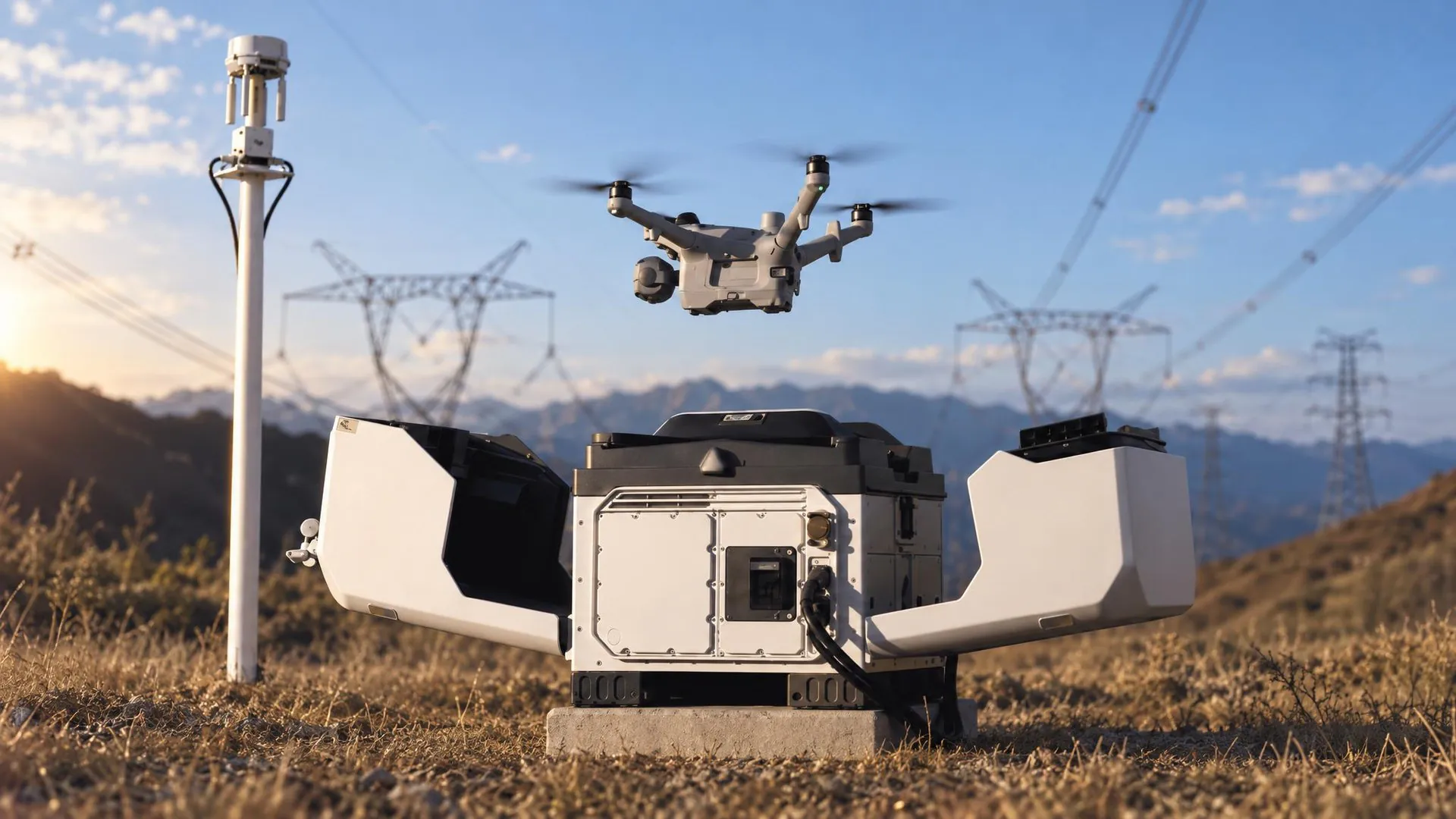
DJI on October 14, 2026 launched DJI Dock 4, which the company described as its first drone-in-a-box system with a fully automated 25-second battery swap, alongside the new DJI Matrice 5TD enterprise drone. DJI positions the system as a dock-as-a-first-responder solution for public safety, emergency response, remote infrastructure inspections, overnight security, and surveying.
Rapid-Response Operation
DJI said the Matrice 5TD can launch instantly once a command is issued remotely and arrive at a scene at up to 21 meters per second, ahead of ground crews, providing real-time situational awareness through a low-latency livestream and high-speed data transfer. With a dedicated video transmission topology, drone-to-cloud latency reaches up to 160 milliseconds, a figure DJI said is down about 32% from the previous generation.
The dock completes a fully automatic battery swap in 25 seconds, which DJI said cuts the turnaround time between flights from a 30-minute recharge to seconds. A single Matrice 5TD flight can last up to 59 minutes, according to the company, covering more area in a single takeoff. When paired with the DJI O4 Ground Station, a drone can also be deployed from a higher position to keep communications stable in obstructed environments.
Imaging and Night Operation
The Matrice 5TD combines telephoto imaging, infrared imaging, laser ranging, and full-color night vision, with DJI stating aerial survey accuracy of up to 10 centimeters at 12 megapixels. The company said the multi-sensor payload covers day-or-night scenarios without swapping airframes.
An 11x telephoto camera with a 252-millimeter equivalent focal length captures details from 400 meters away; DJI said it can resolve pin-level defects on power lines 100 meters away. The infrared camera reaches resolutions up to 2560 × 2048 in UHR mode, with 2K recording and 32x zoom at night. A fusion mode merges the visible-light and infrared feeds using edge or overlay fusion to show structure outlines and heat distribution in one frame. For night work, a 4K high-frame-rate night-vision camera captures full-color images without a spotlight and pairs with a near-infrared auxiliary light for black-and-white night vision. Laser ranging extends to 3 kilometers, overlaying range data and PinPoint coordinates on the feed for powerline inspections, rescue operations, or wildfire estimates.
Obstacle Sensing, Safety, and Payloads
Three-directional millimeter-wave radar, a rotating LiDAR, and a six-directional vision sensing system work together for obstacle sensing that DJI described as wire-level, capable of detecting thin obstacles such as power lines even at night, including inside a substation packed with live equipment or around crossing distribution lines. Six high-resolution low-light fisheye sensors provide full-color, six-directional sensing under city lights at night, the company said. Paired with the O4 Ground Station, the Matrice 5TD’s signal can be extended for deployment around obstructions such as high-rises or substation walls.
DJI said Dock 4 operates in temperatures from −40 to 50 degrees Celsius, auto-preheating the batteries in freezing weather and using air conditioning in high heat. The Matrice 5TD can take off, land, and operate in winds up to 12 meters per second, and its Wind-Exceed Descend-and-Return feature descends and navigates the drone back home if winds spike during its return, even over mountains and forests, according to the company.
Operators can mix and match Matrice 5TD accessories and payloads up to 450 grams, including speakers, spotlights, and parachutes, and a built-in customizable warning light can be activated during security patrols with no additional installation. DJI’s Flight Termination System module, which the company described as a key technical requirement for C6 compliance, can stop the drone’s propellers when triggered manually during operation or automatically when the aircraft breaches its Geocaging boundary.
Onboard AI, Data Security, and Availability
DJI said onboard AI lets the Matrice 5TD detect 17 object types in real time, such as cars, boats, or animals. Through DJI FlightHub 2’s Virtual Cockpit, operators can search for specific objects via text or image, set SMS, email, or platform alerts to flag detected anomalies, and trigger actions such as snapshots, recordings, tracking, or hovering; the software can also run real-time AI detection on live feeds.
On data security, DJI said it has regularly submitted its products for third-party security audits and certification since 2017, naming OnDefend, Booz Allen Hamilton, FTI Consulting, and Kivu Consulting.
DJI Care Enterprise Plus is offered for a dock for the first time with Dock 4, providing free replacement of eligible repair materials within the coverage limit. For the Matrice 5TD, the plan offers coverage-based repair services including one battery replacement per year and a newly added Flyaway Coverage Service, while the DJI Official Extended Warranty Service extends the warranty period by one year.
DJI Dock 4 will be available for purchase through authorized DJI Enterprise dealers. DJI noted that all published data was measured using a production model in a controlled environment, and that some features require pairing with specific DJI drones and may not be available in certain regions and countries.



