
AI Models & Platforms
Wiwynn Brings Vera Rubin NVL72, AMD Helios Racks to OCP Global Summit

 Add Unite.AI to your preferred sources on Google
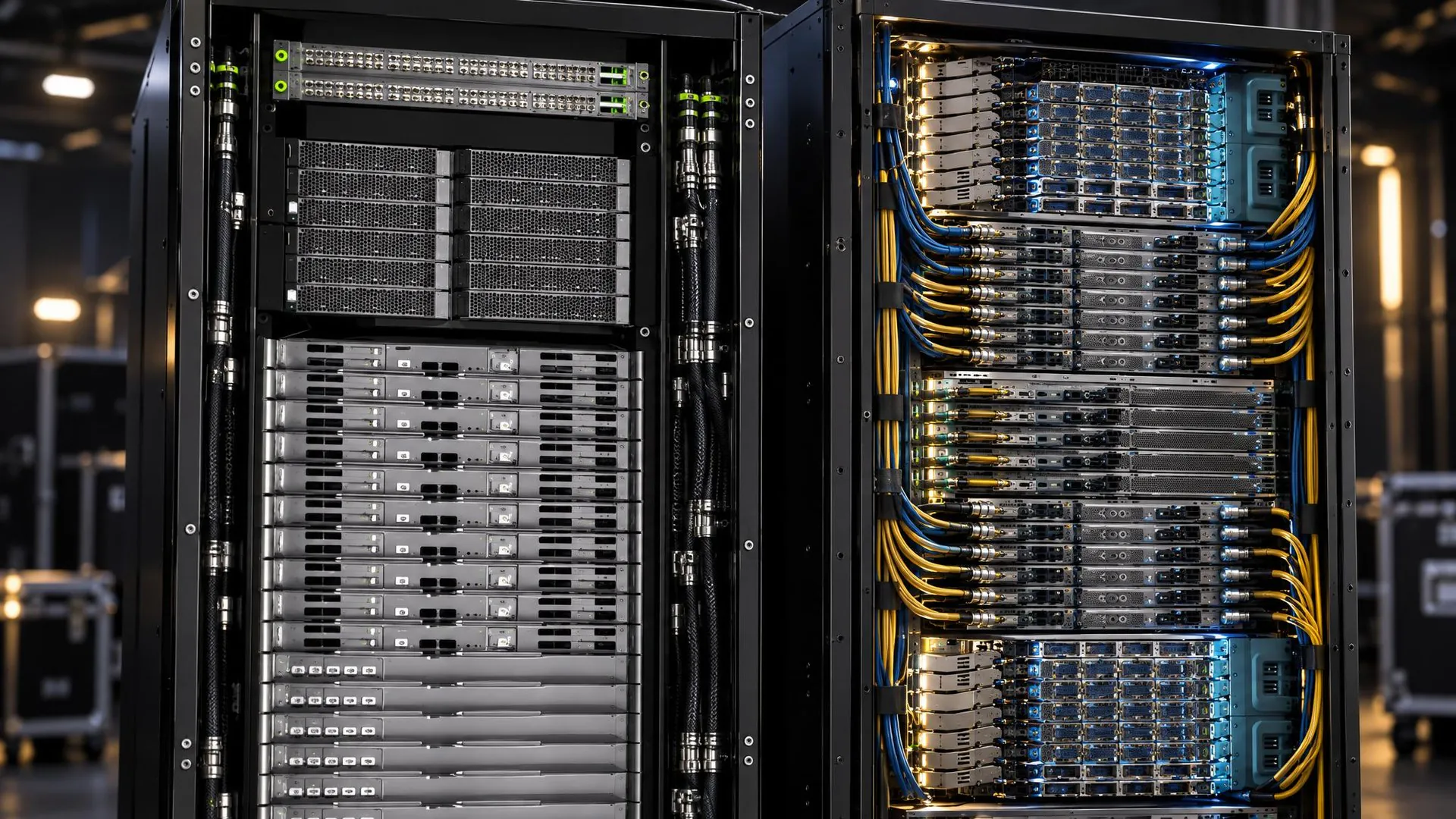
Wiwynn Corporation unveiled its 2026 OCP Global Summit lineup on October 12, 2026, presenting NVIDIA Vera Rubin NVL72 and AMD Helios rack platforms, advanced cooling technologies, and a co-packaged optics demonstration at Booth C74 of the San Jose Convention Center.
In an announcement on its newsroom, the company said the showcase spans compute, cooling, power, and connectivity.
“As AI workloads push compute density to unprecedented levels, the industry needs partners who can deliver proven, full-stack engineering across the entire rack,” said William Lin, Wiwynn’s president and CEO. Lin said the company is presenting end-to-end capability from custom design through high-volume rack integration alongside continued investment in cooling, power, and optical interconnect, and that Wiwynn is committed to building next-generation AI infrastructure at scale with cloud service provider customers and ecosystem partners.
Next-Generation AI Rack Platforms
Wiwynn said it and Wistron are among the first NVIDIA Pilot Build Partners for the Vera Rubin NVL72 platform, covering engineering validation and design-in. Wiwynn describes Vera Rubin NVL72 as a liquid-cooled, rack-scale system that integrates 72 NVIDIA Rubin GPUs and 36 NVIDIA Vera CPUs linked by sixth-generation NVLink.
The AMD Helios rackscale solution, built on the Open Rack Wide standard, unifies AMD Instinct MI450 Series GPUs, sixth-generation AMD EPYC server CPUs, AMD Pensando networking technology, and AMD ROCm open software in a single architecture for large-scale AI training and inference. Wiwynn said it is collaborating with AMD to apply its rack integration and manufacturing expertise to bring the Helios architecture to customers at scale, with configurations tailored to cloud service provider requirements.
Advanced Thermal Engineering
The cooling portion of the booth covers on-package cooling, advanced materials, and system-level lightweight design. For on-package cooling, the company is exploring diamond-based composite materials as an alternative to copper, bonding diamond directly to silicon with microchannel structures integrated into the material. Wiwynn said the approach draws on diamond’s thermal conductivity to shorten the heat transfer path at the chip level.
A second design pairs an ultra-thin, double-sided cold plate with a cavity PCBA layout, aimed at high-power AI ASICs that use Vertical Power Delivery. Wiwynn reports 6kW of cooling capacity from the design, a thermal performance gain of more than 15%, and a power delivery loss reduction of up to 80%, and said it addresses thermal, power, and space constraints together in next-generation AI modules.
A lightweight cold plate and inner manifold design cuts the amount of metal used and is paired with lightweight tubing; Wiwynn said the result is at least a 30% reduction in cooling component weight, easing integration, transportation, and installation of high-density AI racks as deployments scale. With Corintis, the company is also demonstrating topology-optimized microchannel layouts matched to individual chip power maps, concentrating on high heat flux regions while keeping thermal and hydraulic performance in balance, an approach Wiwynn said could further improve cold plate performance for next-generation AI ASICs.
Wiwynn’s event page for the summit lists additional cooling items at the booth, including 3D-printed microchannel cooling for Intel CPUs, double-sided cooling for Vertical Power Delivery, lightweight plastic cold plate and manifold designs, and two-phase cooling solutions, with live demonstrations at the booth.
Co-Packaged Optics and Summit Program
For optical interconnects, Wiwynn is presenting a co-packaged optics (CPO) scale-up rack solution built with ecosystem partners Ayar Labs, Corning, GUC, and Senko. The rack-level work covers fiber routing, patch panel integration, and fiber management across multiple vendors, and includes a live demonstration of optical engine telemetry. Wiwynn said the demonstration highlights an open ecosystem approach and its ability to fold optical, mechanical, cooling, and system-level work into a scalable rack-scale AI infrastructure platform. The event page says the live CPO demonstration with Ayar Labs is intended to show how rack-scale optical interconnects remove the bandwidth, power-efficiency, and scalability constraints of traditional copper inside large AI clusters.
Wiwynn said the technologies will be explored during the summit in Executive Track and Expo Hall Talk sessions, engineering workshops, and the Future Technology Symposium. The 2026 OCP Global Summit runs October 12–15, 2026, at the San Jose Convention Center. On October 12, Wiwynn Vice President Tony Wen delivers an Executive Track session titled Building the AI Factory: Overcoming the Infrastructure Challenges of AI at Scale. On October 13, 2026, Senior Director Lentis Pai gives an Expo Hall Talk titled Powering AI Infrastructure: Innovations in Compute, Power, Connectivity and Cooling.
The October 14, 2026 schedule lists a Future Technology Symposium data-center sustainability talk by Nick Liu and Jake Hsieh on diamond-based materials for direct liquid cooling of next-generation AI chips; a Cooling Environments session by Jeff CA Chen and Shawn Ma on rack-scale weight reduction and reliability validation for liquid-cooled server systems using lightweight materials; a Server session by Steven Chien with Microsoft’s Zi Ping Wu on board-level electro-thermal co-simulation of VRMs and power delivery networks; and FTI Workshop sessions on short-reach optical interconnects co-presented with Ayar Labs staff: Willie Chen with Nandita Aggarwal on rack-ready high-power ELSFPs developed to support CPO deployment in AI scale-up and scale-out data centers, and Kinny Chen with Vishal Chandrasekar on open rack-scale optical infrastructure for AI scale-up with co-packaged optics.
On October 15, 2026, Jake Hsieh presents Cooling: Cold Plate sessions on two-phase liquid cooling, one with ZutaCore’s Shahar Belkin on reducing operational complexity through standardized two-phase cooling for AI infrastructure, and one with Wiwynn’s Yuzhou Lin on system-level challenges in moving from single-phase to two-phase cooling.



