
AI Models & Platforms
ASUS Debuts XA P2N-E2 Server With Dual NVIDIA Vera CPUs at OCP

 Add Unite.AI to your preferred sources on Google
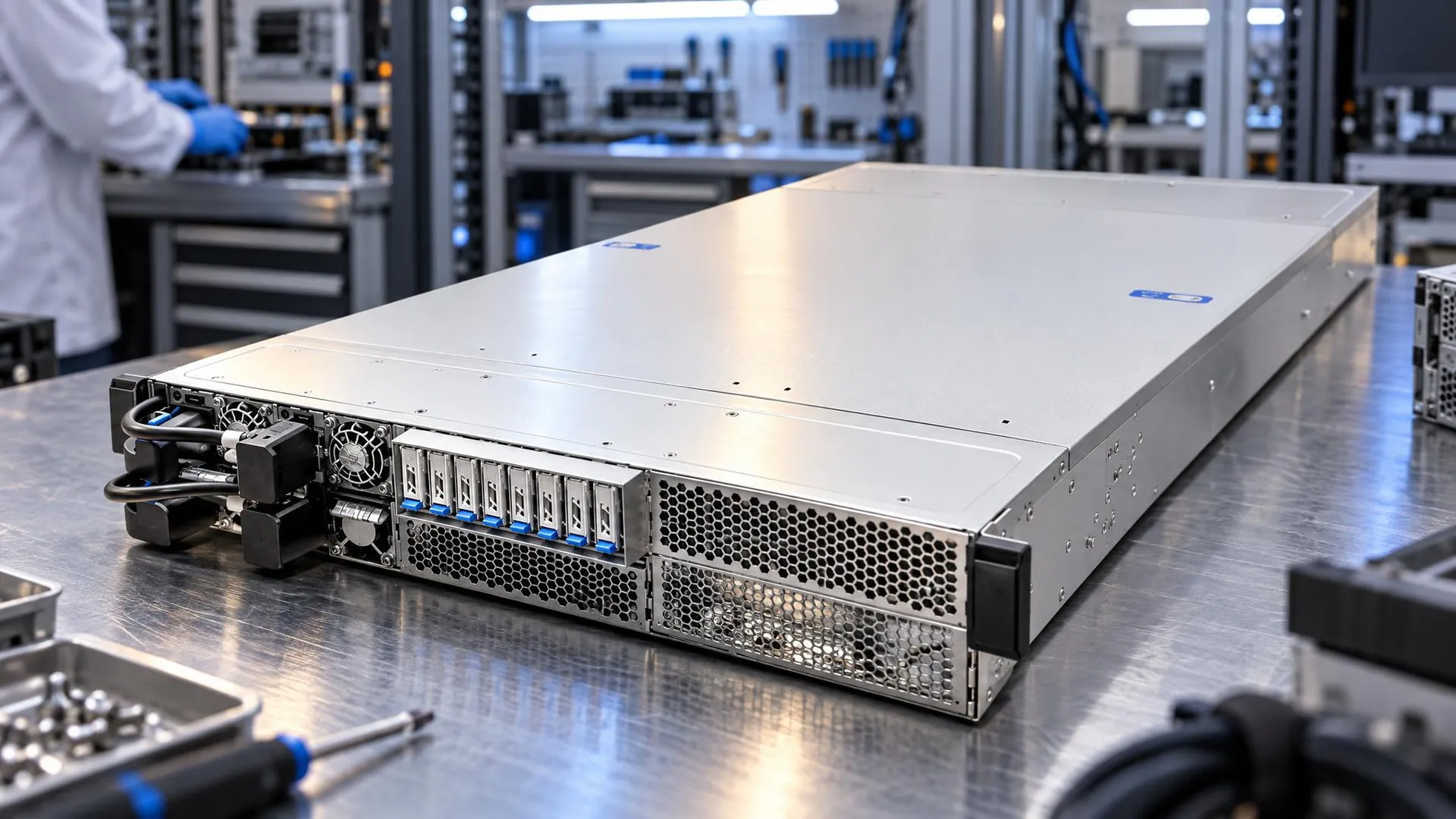
ASUS unveiled the XA P2N-E2, a 2U server built on NVIDIA MGX architecture and powered by dual NVIDIA Vera CPUs, at OCP Global Summit 2026 in San Jose, California, on October 12, 2026. In a press release, the company said the system is designed for agentic AI and reinforcement learning workloads.
According to the release, the server targets the execution layer of AI applications, handling code execution, tool use, sandboxing, data processing and orchestration, work that extends beyond the AI model itself. The XA P2N-E2 supports up to two dual-slot NVIDIA RTX PRO 6000 Blackwell Server Edition GPUs, combining CPU computing with GPU acceleration in the 2U platform. ASUS said the system’s single-thread CPU performance and high-bandwidth, energy-efficient memory are intended to keep AI agents responsive during demanding execution and evaluation tasks.
Dual Vera Processors in an Air-Cooled 2U Chassis
The XA P2N-E2 product page, which carries a “NEW” designation, lists dual NVIDIA Vera processors, each integrating 88 custom Olympus cores with Spatial Multithreading for 176 threads, at up to 480W TDP per socket. ASUS describes Vera as the first CPU purpose-built for AI agents: under the workflow ASUS outlines, the CPU handles sandboxed code execution, tool use, orchestration and data processing while GPUs remain dedicated to training and inference.
Second-generation NVIDIA NVLink-C2C provides up to 1.8TB/s of coherent CPU-to-CPU communication, with core-to-core bandwidth of up to 3.4TB/s, according to the product page. Memory comes from 16 SOCAMM2 modules running LPDDR5X at 9600MT/s with up to 1.5TB of capacity, and ASUS says the configuration delivers up to twice the energy efficiency of traditional RDIMM memory and 50% lower memory power consumption.
Storage consists of eight hot-swap E1.S drive bays, and expansion includes two PCIe Gen6 x16 slots plus a dedicated dual-slot DPU/NIC slot. The fully air-cooled chassis uses front-to-back airflow across the processor, memory and GPU zones with 2+2 redundant 2000W 80 PLUS Titanium power supplies, and requires no liquid-cooling infrastructure. Under the MGX modular design, the host processor module and the GPU bay, which houses up to two dual-slot RTX PRO 6000 Blackwell Server Edition GPUs at up to 600W each, are independently serviceable.
Four Hardware Bottlenecks ASUS Identifies for Agentic AI
In an August 10, 2026 insight, ASUS identified four hardware bottlenecks it said constrain agentic AI deployments: insufficient single-thread performance at scale, inadequate per-core memory bandwidth, cross-die data-access latency, and the lack of hardware-level sandbox isolation. The company said the XA P2N-E2 addresses the last of these with hardware-level sandbox isolation for agent code execution, and credited the Vera CPU with up to 1.8x the single-thread performance of traditional x86 CPUs, sandbox code execution at 1.8x that of traditional x86 infrastructure, and coding workflows up to 1.5x faster. ASUS tied those figures to the Vera CPU’s 88-core design, up to 1.2TB/s of LPDDR5X memory bandwidth and 3.4TB/s of internal interconnect bandwidth.
That August insight had already described the XA P2N-E2 as launched alongside ASUS servers based on AMD EPYC 9006 processors, the RS700A-E14B, RS720A-E14B and XA P8A-E14A series. For those systems, ASUS cited up to 256 cores per socket and roughly 70% higher overall performance than the previous generation, with 16-channel DDR5 memory delivering approximately 1.6TB/s of bandwidth.
Rack-Scale Systems and NVIDIA Platform Technologies
Beyond the 2U server, ASUS is also showing rack-scale systems at OCP. The XA VR721-E3 ASUS AI POD integrates 36 NVIDIA Vera CPUs and 72 NVIDIA Rubin GPUs through the NVIDIA Vera Rubin NVL72 platform in a fully liquid-cooled architecture for large-scale AI training, post-training and inference. The XR R1I12B-M1BHFS combines NVIDIA HGX Rubin NVL8 with direct-to-chip liquid cooling for the GPU baseboard and air cooling for Intel Xeon 6 processors.
ASUS also cited the NVIDIA DSX reference design and the NVIDIA Omniverse DSX Blueprint, which it said bring validated architecture and high-fidelity simulation together to build physically accurate digital twins for optimizing AI factory design and operations before deployment. Four NVIDIA technologies are featured at the ASUS booth: HGX Rubin NVL8 accelerated computing, Spectrum-X Ethernet switching based on Spectrum-6, the CMX Context Memory Storage Platform, and the Groq 3 LPX inference accelerator for Vera Rubin NVL72, which the release describes as extending the NVL72 platform with ultrafast token generation for highly responsive inference.
Intel and AMD Showcase Systems
The Intel showcase features the RS700-E12-RS4U and RS720-E12-RS12U, 1U and 2U dual-socket servers powered by Intel Xeon 6 processors with DC-MHS designs and tool-less serviceability, aimed at agentic AI, virtualization and data-intensive workloads. The AMD showcase introduces the RS700A-E14B-R16U, a 1U dual-socket system built on 6th Gen AMD EPYC 9006-series processors codenamed “Venice,” combining DC-MHS architecture with PCIe 6.0 connectivity and support for up to 16 E3.S drives, with ASUS Thermal Radar 3.0 providing thermal monitoring and management.
For accelerated AI, the ESC8000A-E13P supports AMD Instinct MI350P PCIe accelerators, while the XA AM3A-E13 integrates eight AMD Instinct MI355X accelerators in a 10U air-cooled design that ASUS said enables high-density deployments without dedicated chilled-water infrastructure. The complete portfolio is on display at ASUS booth #B9 during OCP Global Summit 2026, and ASUS said its servers are available worldwide, with availability of individual products and configurations varying by region.



