
Opinion
Jev and the New Decision Layer for AI Agents

 Add Unite.AI to your preferred sources on Google

Why System One models could separate fast judgment from slow reasoning
Many AI agents utilize a language model for nearly all their decisions. The language model picks a tool, evaluates results, determines if it needs to keep going, and finally generates answers. Flexible; however, this process can be costly when yes-or-no decisions are repeated at scale. Unite.AI has previously discussed how agentic workflows increase model calls, context, and retries. Every additional decision can add time and money prior to providing users with useful information.
Jev suggests splitting the task differently. Utilize a model built for bounded judgments in which the answer set is defined. Utilize a generative model for open-ended reasoning and language. Jev suggests that the main thought here isn’t that all agents need to purchase one new product. The key concept is an agent doesn’t need the same type of intelligence at every point.
What Jev Actually Does
TypeSafe launched Jev in September of 2026, the first of their new System One models. Jev doesn’t write out prose. Instead, you send it a state (like a support message and user data). You also send one or more questions that have predefined answer types. Then Jev responds with typed answers and probabilities.
According to the company’s official documentation, there are three primitives for making judgments:
- Choice lets you choose from among predefined options.
- Score lets you rate something against an ordered rubric.
- Noul estimates the probability that a statement is true.
You can ask multiple independent questions about the same state within one request.
For example, let’s say you’re handling a customer service issue. A system might want to figure out which team should handle this case. It may also determine how quickly someone needs to respond and see if the customer requested a refund.
A chat model could potentially perform all three tasks. However, it will need to provide the results back to your app as a structured response. In contrast, Jev provides only those bounded decisions. Your app would then decide what action to take next based upon those decisions.
The Architectural Shift Matters More Than the Model
The majority of these debates compare large models to small ones. Jev proposes an alternative boundary. Some steps involve language generation. Others are narrow judgments which software can consume.
This creates a decision layer in the agent. The model will estimate. Software will apply policy. If the estimated probability exceeds a tested threshold and the action is low-risk and reversible, the workflow may continue. If there is uncertainty in the results or if the action could have serious implications, the system can seek human oversight. A reasoning model may help investigate the uncertainty, but it does not replace required human approval.
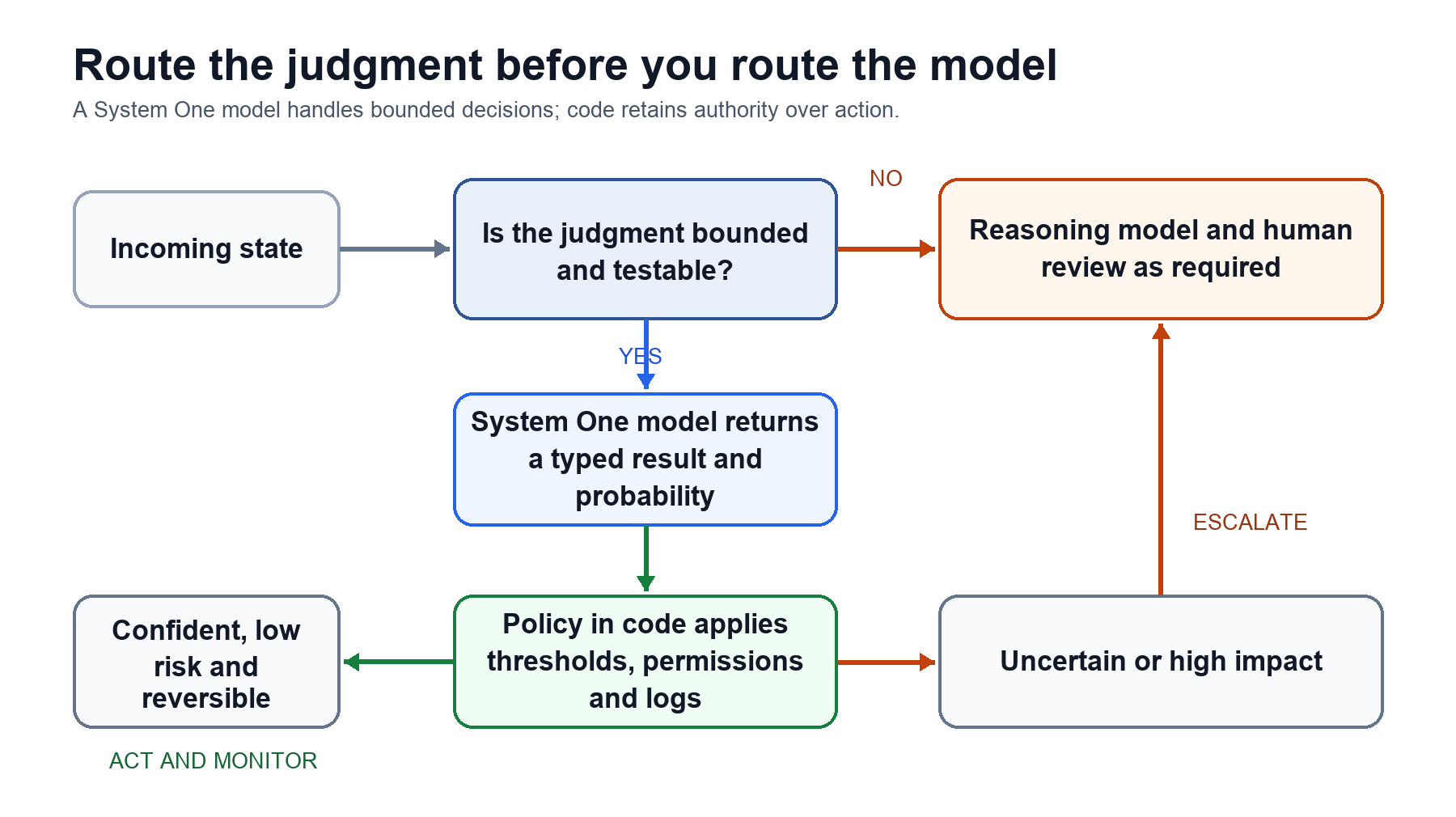
Figure 1. A bounded decision path keeps thresholds, permissions, and escalation in code.
There are similarities with model routing, but there is a critical difference. RouteLLM makes decisions about which of two language models to choose from. It selects between a stronger and a weaker model to balance quality and price. A System One model produces bounded judgments that code can use directly. These judgments can support model routing as well as other decisions within an agent.
Why Agent Loops Are a Natural Fit
The nature of agent loops makes them particularly suited for making numerous judgments at very small levels. These judgments help reach the final output. In other words, agents have to make a lot of “little” judgments after a user submits their question or request. Those judgments happen before the answer or output is returned.
An example would be deciding what tools to utilize, ranking retrieved records, and evaluating risk. The system also determines if enough evidence exists and whether the process should continue. Most likely these will all occur repeatedly. As well, delays between each loop can compound over time.
This role for agent loops is exemplified by LangChain’s Jev integration, where Jev can perform both model routing and tool-call checks. While Jev integrates around the edges of the generative model, the generative model itself continues to plan and generate content. This represents a far more realistic use case for Jev. It complements a general-purpose language model rather than replacing it.
Additionally, parallelizing questions also changes the way teams think about decomposing tasks. Specifically, teams are able to break down one ambiguous instruction into multiple discrete evaluation questions. This can potentially result in a much shorter sequence of model calls. It can create a workflow that is much easier to evaluate. It also allows developers to use explicit business logic to combine the resulting judgments.
General-purpose language models can produce structured output and might be the better choice in some cases. For example, a determination and an explanation may need to be provided together. Therefore, Jev must demonstrate more than just schema compliance to be considered effective.
The effectiveness of Jev is dependent upon achieving reductions in overall system latency. It also depends on producing useful probability estimates and exhibiting stability in performance across varying inputs. Should Jev fail to deliver these benefits, selecting another model will merely add additional development and operational overhead.
Does Typed Mean Correct?
Language used when making claims about Jev needs to be carefully worded as well. Since the output space is defined ahead of time, the model should not return an invented field or an unparseable paragraph. That eliminates one form of failure; it doesn’t eliminate semantic error. There’s nothing preventing a system from returning an incorrect department, assigning an incorrect risk level, or stating too much certainty. It can do all of this while being completely type-safe.
TypeSafe’s own System One documentation makes an important distinction. Calibration is measured across groups of predictions; it does not guarantee correctness of an individual prediction. In production, this has implications. Teams need to test whether predicted probabilities match observed outcomes on their own data.
Performance evidence remains early
TypeSafe reports response times of 70 to 500 milliseconds. It also references substantial cost savings and speed improvements in its internal workflow evaluations. Additionally, TypeSafe indicates that those headline gains are likely near the high end of real-world gains. TypeSafe’s publicly available workflow testing uses reference probabilities provided by other frontier models rather than ground-truth labels. Results are good for forming hypotheses. Results cannot replace an independent test against a real workload.
A Practical Test Before Adoption
When you build your first AI-powered decision workflow, do not choose your most critical decisions (for example, medical approvals or account suspensions). Instead, pick something which is very common, reversible, and easy to review by other people on the team. That includes but is certainly not limited to ticket routing, document categorization, model selection, and low-risk quality assurance.
Four questions will help you judge whether this is going to work:
- Does the output have a finite number of possible answers?
- Can you clearly articulate the criteria for the judgment?
- Are there measurable outcomes? Track the prediction, its probability, the action, and the subsequent results. Check calibration regularly by comparing predicted probabilities with observed outcomes.
- Do you have an alternate plan in case the automated decision process fails? Identify a specific point when to use a reasoning model, ask for more information, or involve a human.
Your analysis should include the entire workflow, including the decision-making process. Use metrics such as decision accuracy, abstention or escalation rates, total end-to-end processing time, cost per successfully completed task, and impact of mistakes. Run tests under adverse conditions: varying word usage, omitting relevant data, infrequent categories, and adversarial inputs. An optimized classifier that generates additional costs downstream is not an optimization.
The Long-Term Lesson Here
If Jev succeeds, changes significantly, or is replaced rapidly, one thing remains constant. The architectural question remains. Is it necessary to have every machine-based decision rendered as generated language?
In many cases, the answer is “no.” In a production environment, a system using generative models can generate interpretations, plans, and explanations. Using bounded decision models, the same system can route, score, and gate. The code can continue to dictate acceptable threshold values and permissions. Humans should remain responsible for decisions that affect others’ lives.
While this represents a less dramatic perspective than having one autonomous model perform all tasks reliably, it reflects how reliable systems are created. The next advance in performance for agents may depend upon selecting those areas in the system where thinking takes longer. Other areas need quick decisions, and some require no action at all.



