
AI Fundamentals
What Is Agentic RAG? When AI Plans Its Own Search and Retrieval
Agentic RAG lets an AI system plan, reformulate, and iterate over retrieval rather than making one fixed search before generation. This guide explains the mechanism, trade-offs, evaluation, and controls that matter in practice.

 Add Unite.AI to your preferred sources on Google
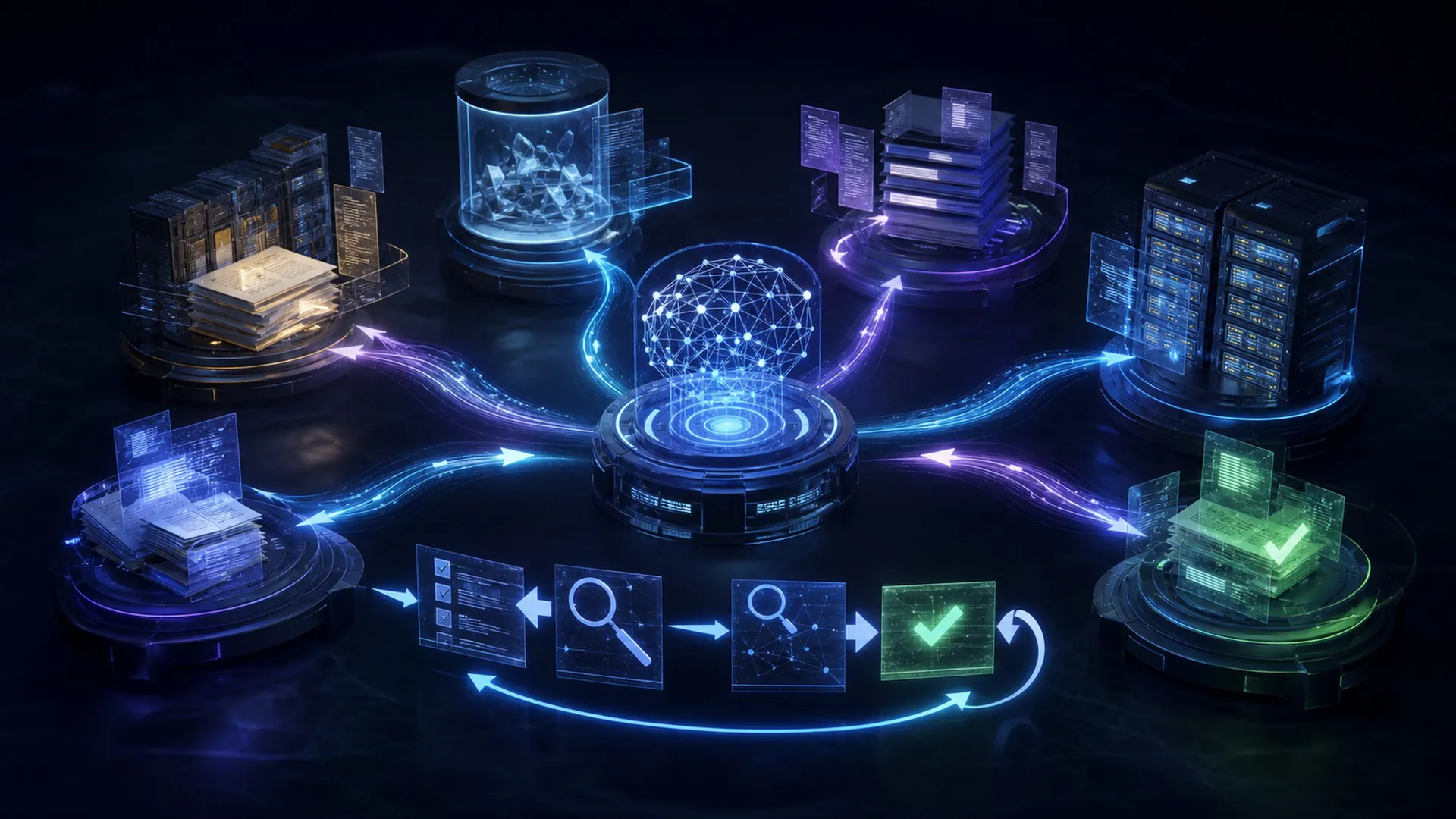
Agentic RAG lets an AI system plan, reformulate, and iterate over retrieval rather than making one fixed search before generation.
Agentic RAG deserves a precise explanation because its name identifies a particular information flow, training choice, runtime mechanism, or governance boundary. Treating it as a synonym for “advanced AI” makes claims impossible to test. This guide follows the concept from its input and assumptions through its observable result, then tests the shortcut most likely to be confused with it.
Agentic RAG: Definition, Boundary, and Purpose
Agentic RAG lets an AI system plan, reformulate, and iterate over retrieval rather than making one fixed search before generation. The definition contains three practical commitments: there is an identifiable input, a transformation or decision that is characteristic of Agentic RAG, and an outcome that can be evaluated against a stated objective. If one of those elements is missing, the label may describe an aspiration rather than an implemented mechanism.
Retrieval systems are pipelines. Parsing, representation, indexing, candidate generation, ranking, context assembly, and answer generation can each create or remove evidence. For Agentic RAG, this system view matters because performance can be determined by the surrounding data, interfaces, hardware, permissions, and people even when the underlying model is unchanged. A useful explanation therefore separates the model’s learned behavior from the product that decides when, where, and with what authority that behavior is used.
The nearest misleading shortcut is single-pass RAG with one query and one retrieved context. It may share a visible feature with Agentic RAG, yet it changes the causal story: different evidence would establish success, different resources would dominate cost, and different controls would prevent harm. The boundary is therefore operational rather than terminological.
A Five-Stage Operating Map of Agentic RAG
The diagram is a compact causal map for Agentic RAG, not a claim that every implementation uses five software components. Some systems combine stages and others repeat them in a loop. The map remains useful because it forces each change in information or authority to have an owner, an input, an output, and a test.
1. Interpret the Question and Missing Evidence: Input and Assumptions in Agentic RAG
At this stage of Agentic RAG, the system must interpret the question and missing evidence. The useful question is not merely whether that operation occurs, but which information it consumes, which state it changes, and what evidence proves that the change was valid. A reviewer should be able to distinguish the operation from single-pass RAG with one query and one retrieved context and reproduce its result under the same stated conditions.
The handoff into this Agentic RAG stage begins with the stated objective and should end with a result that can support choose a source or search strategy. Record uncertainty, rejected alternatives, resource use, and any human or software control applied at the boundary. That trace is where teams can detect whether more autonomous search increases cost and can drift away from the original question before the same weakness reaches a consequential output.
2. Choose a Source or Search Strategy: Representation or Decision in Agentic RAG
At this stage of Agentic RAG, the system must choose a source or search strategy. The useful question is not merely whether that operation occurs, but which information it consumes, which state it changes, and what evidence proves that the change was valid. A reviewer should be able to distinguish the operation from single-pass RAG with one query and one retrieved context and reproduce its result under the same stated conditions.
The handoff into this Agentic RAG stage begins with interpret the question and missing evidence and should end with a result that can support inspect retrieved results. Record uncertainty, rejected alternatives, resource use, and any human or software control applied at the boundary. That trace is where teams can detect whether more autonomous search increases cost and can drift away from the original question before the same weakness reaches a consequential output.
3. Inspect Retrieved Results: Distinctive Transformation in Agentic RAG
At this stage of Agentic RAG, the system must inspect retrieved results. The useful question is not merely whether that operation occurs, but which information it consumes, which state it changes, and what evidence proves that the change was valid. A reviewer should be able to distinguish the operation from single-pass RAG with one query and one retrieved context and reproduce its result under the same stated conditions.
The handoff into this Agentic RAG stage begins with choose a source or search strategy and should end with a result that can support reformulate, branch, or verify as needed. Record uncertainty, rejected alternatives, resource use, and any human or software control applied at the boundary. That trace is where teams can detect whether more autonomous search increases cost and can drift away from the original question before the same weakness reaches a consequential output.
4. Reformulate, Branch, or Verify as Needed: Constraint and Verification Boundary in Agentic RAG
At this stage of Agentic RAG, the system must reformulate, branch, or verify as needed. The useful question is not merely whether that operation occurs, but which information it consumes, which state it changes, and what evidence proves that the change was valid. A reviewer should be able to distinguish the operation from single-pass RAG with one query and one retrieved context and reproduce its result under the same stated conditions.
The handoff into this Agentic RAG stage begins with inspect retrieved results and should end with a result that can support synthesize only after the evidence threshold is met. Record uncertainty, rejected alternatives, resource use, and any human or software control applied at the boundary. That trace is where teams can detect whether more autonomous search increases cost and can drift away from the original question before the same weakness reaches a consequential output.
5. Synthesize Only After the Evidence Threshold Is Met: Output, Feedback, and Stop Rule in Agentic RAG
At this stage of Agentic RAG, the system must synthesize only after the evidence threshold is met. The useful question is not merely whether that operation occurs, but which information it consumes, which state it changes, and what evidence proves that the change was valid. A reviewer should be able to distinguish the operation from single-pass RAG with one query and one retrieved context and reproduce its result under the same stated conditions.
The handoff into this Agentic RAG stage begins with reformulate, branch, or verify as needed and should end with a result that can support monitoring or a final decision. Record uncertainty, rejected alternatives, resource use, and any human or software control applied at the boundary. That trace is where teams can detect whether more autonomous search increases cost and can drift away from the original question before the same weakness reaches a consequential output.
Read the Agentic RAG map forward to understand production and backward to diagnose failure. Forward analysis asks how one stage supplies the next. Backward analysis starts from an incorrect, slow, expensive, or unsafe result and traces which earlier assumption allowed it. The reverse path is often where a team discovers that the decisive error occurred before the model produced anything.
A Worked Agentic RAG Example
A research agent can search filings, notice a missing year, issue a targeted follow-up query, and reconcile conflicting figures.
This example is informative because Agentic RAG can be tied to observable inputs, intermediate states, and an outcome rather than judged through a polished demonstration. A rigorous test would build ordinary, difficult, and deliberately misleading cases around the scenario, preserve a baseline without the technique, and record both average performance and the severity of individual failures.
Change one assumption in the Agentic RAG example and repeat the analysis. Remove a required input, introduce a conflicting signal, limit compute, alter the user population, or force the system to abstain. A mechanism that only succeeds under one carefully arranged demonstration has not established that it generalizes to the operating environment.
Agentic RAG vs. Its Most Common Shortcut
Agentic RAG is often reduced to single-pass RAG with one query and one retrieved context. That reduction removes the very boundary that defines the concept. It can lead buyers to compare unlike products, researchers to overstate what an experiment demonstrates, and operators to monitor the wrong signal after deployment.
| Lens | Practical answer |
|---|---|
| Definition | Agentic RAG lets an AI system plan, reformulate, and iterate over retrieval rather than making one fixed search before generation. |
| Confusion | single-pass RAG with one query and one retrieved context. |
| Risk | more autonomous search increases cost and can drift away from the original question. |
The comparison should also identify the unit of analysis. A paper about Agentic RAG may isolate a model or algorithm, while a deployed service adds retrieval, routing, caching, policy, identity, user interfaces, and monitoring. Two products can use the same headline term while implementing different parts of that stack. Ask which component performs the defining transformation and which other components are necessary for the reported outcome.
Why Agentic RAG Matters in Current AI Systems
Agentic RAG matters now because AI systems are being given larger contexts, more modalities, more runtime compute, broader tool access, and deeper connections to organizational decisions. Under those conditions, what once looked like a research detail can determine latency, security, accessibility, environmental cost, product quality, or legal accountability.
The relevant measure is not whether Agentic RAG can produce one impressive result. It is whether the technique improves an outcome that matters across representative conditions and does so more effectively than a simpler baseline. Report distributions, failure categories, tail latency, resource use, and affected subgroups rather than compressing every result into one average.
Evaluate retrieval separately from generation with answer-bearing documents, then evaluate the combined system for groundedness, citation correctness, abstention, freshness, access control, latency, and cost. Applied specifically to Agentic RAG, that discipline makes the evidence portable: another team can judge whether the claimed gain is likely to survive a different model, language, hardware platform, dataset, user population, or risk tolerance.
Benefits Agentic RAG Can Deliver
The strongest reason to use Agentic RAG is that it can address its intended bottleneck directly. Depending on the implementation, the benefit may appear as better grounding, a more faithful representation, improved generalization, lower latency, reduced memory movement, clearer accountability, or a safer boundary between a model proposal and a real action.
Benefits should be expressed as decisions and measurements. “More intelligent” is not an acceptance criterion for Agentic RAG. A useful target might specify error rate on hard cases, recovery after conflicting evidence, cost at a percentile of traffic, human-review time, calibration, or the percentage of actions kept within a defined authority limit.
The Failure Mode That Defines Agentic RAG
The central limitation is that more autonomous search increases cost and can drift away from the original question. This failure is not an afterthought to list once development is complete. It should shape data collection, architecture, permissions, evaluation, release gates, and monitoring for Agentic RAG from the beginning.
A control for Agentic RAG is useful only if it acts before an expensive or irreversible consequence. Identify the earliest observable precursor to the failure, set a threshold or rule, assign an accountable owner, and test recovery. Depending on the use case, recovery may mean abstaining, falling back to a simpler system, requesting more evidence, escalating to a person, rolling back a model, or stopping an action entirely.
An Evaluation Plan for Agentic RAG
Begin evaluation of Agentic RAG by writing the decision the evidence must support. Define the operating population, consequence of a wrong result, information actually available at decision time, and the simplest credible alternative. This prevents a benchmark from becoming the goal simply because it is easy to run.
Use an untouched test set for controlled comparisons, then validate Agentic RAG in a staged operating environment. Offline evaluation makes variants comparable; shadow mode, canaries, rate limits, or approval gates reveal how real traffic, feedback loops, and people change behavior. The deployment stage should have an explicit stop condition rather than assuming every improvement deserves full rollout.
Version the inputs needed to reproduce Agentic RAG: source data, preprocessing, tokenizer or encoder, model weights, configuration, prompt or policy, retrieval index, evaluation set, hardware assumptions, and serving code as applicable. Without lineage, a team cannot tell whether a changed result came from the technique, the environment, or an unnoticed pipeline edit.
Finally, ask what finding would falsify the claim that Agentic RAG helps. If no result could reverse the adoption decision, the evaluation is marketing. Precommitted acceptance thresholds and a preserved confirmation set turn the exercise into evidence.
Questions to Ask Before Adopting Agentic RAG
- Objective: Which measurable bottleneck is Agentic RAG intended to solve?
- Mechanism: Which of the five stages contains the distinctive transformation?
- Baseline: How does it compare with single-pass RAG with one query and one retrieved context or another simpler alternative?
- Evidence: Which ordinary, difficult, adversarial, and subgroup cases were tested?
- Operations: What latency, memory, compute, energy, maintenance, and review costs appear at scale?
- Risk: How will the team detect that more autonomous search increases cost and can drift away from the original question?
- Recovery: Can the system abstain, fall back, roll back, or escalate before harm?
Primary Sources for Studying Agentic RAG
Authoritative starting points for the part of the AI stack surrounding Agentic RAG include Retrieval-Augmented Generation paper, FAISS similarity search research, Microsoft GraphRAG. Read them alongside the documentation for the exact model, dataset, hardware, and jurisdiction involved. A general source can define the mechanism, but only deployment-specific evidence can establish that a particular implementation is suitable.
What to Remember About Agentic RAG
Agentic RAG is a defined mechanism inside a larger sociotechnical system. Its value comes from improving a specific outcome under explicit conditions, not from the label itself. The five-stage map makes its information flow visible, the comparison identifies what it is not, and the control path shows where a responsible operator can intervene.
The practical rule for Agentic RAG is to define the objective, compare against a credible baseline, test the failure that matters most, and retain the evidence needed to monitor change. With those pieces in place, the concept becomes an engineering and governance choice that can be evaluated. Without them, it remains a promising name attached to an unknown operating risk.



