AI Models & Platforms
Physics Could Transform Computing and AI forever

 Add Unite.AI to your preferred sources on Google

In a departure from decades of computational tradition, a team of researchers at Unconventional AI has developed a method for generating images that relies not on the silicon chips and electrical currents that power today’s artificial intelligence systems, but rather on the fundamental principles of physics itself.
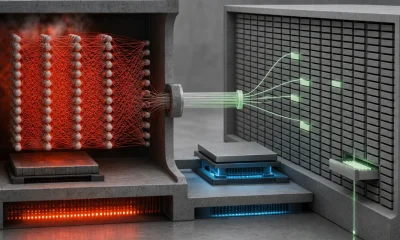
The system, called Un-0, represents an emerging philosophy in artificial intelligence development: rather than building larger and more complex computer networks, scientists are exploring whether the mathematical patterns found in nature can perform the same computational work while using around 1000x less energy.
Energy and Efficiency
The artificial intelligence systems that have dominated the technology landscape, such as neural networks, language models, and recommendation algorithms, require enormous amounts of energy to operate.
Data centers housing these systems consume power equivalent to that of small cities, raising concerns about both environmental impact and long-term sustainability.
Researchers estimate that achieving the next significant breakthrough in artificial intelligence efficiency will require a fundamentally different approach to how machines process information.
This realization has prompted scientists to look toward nature for inspiration, examining biological and physical systems that have evolved over millennia to solve complex problems with remarkable efficiency.
Understanding Coupled Oscillators
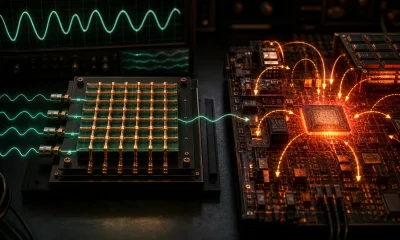
At the heart of Un-0 lies a deceptively simple concept drawn from physics: coupled oscillators.
To understand this, one can imagine a pair of metronomes, the mechanical devices musicians use to keep time. If two metronomes are placed on the same table and set to different tempos, something remarkable occurs. Through vibrations in the surface beneath them, the metronomes gradually influence one another until they eventually fall into synchronization, ticking in unison.
This synchronization follows precise mathematical principles that have been studied in physics for more than a century. The interaction between oscillators creates patterns of organization that emerge without any external direction or control, they organize themselves.
Now imagine expanding this concept dramatically. Instead of two metronomes, picture thousands of oscillating units, each capable of influencing every other unit around it.
Each oscillator possesses several properties: a natural frequency at which it wants to rotate, a phase angle that describes its current position in its oscillation cycle, and connections to every other oscillator that determine how strongly each pair influences one another.
These connections, called coupling strengths, are the aspects that Un-0 learns during training.
This system mirrors mathematical models known as Kuramoto oscillators, named after physicist Yoshiki Kuramoto who studied such systems decades ago. Until recently, these models remained largely theoretical.
Un-0 demonstrates that they can be scaled to address practical artificial intelligence problems at a level of sophistication previously considered the domain of conventional deep learning.
Performance and Comparison
Testing has shown that Un-0 achieves image quality comparable to the leading artificial intelligence image generation methods from several years ago.
On a standard benchmark called ImageNet 64×64, the system achieved a quality score that matched the performance of prominent conventional generators when those systems were first published.
This represents neither defeat nor breakthrough. Rather, it demonstrates proof of principle: systems grounded in physics-based dynamics can generate images at a quality level previously considered exclusive of deep learning, a detail that suggests significant potential for future development.
The researchers acknowledge that current state-of-the-art systems, which have undergone years of refinement, still outperform Un-0. However, they point out that conventional image generators also began with modest results before decades of optimization transformed them into today’s sophisticated tools.
Why Physics-Based Computing Matters
The significance of Un-0 extends far beyond image generation. Systems based on physical dynamics performing artificial intelligence tasks while consuming a thousand times less energy than conventional approaches, the implications would be transformative.
Such efficiency gains could enable artificial intelligence applications to run on mobile devices, embedded systems, and remote locations without access to massive data centers.
Moreover, these systems might eventually be implemented directly in physical hardware, silicon chips designed to simulate natural physical processes rather than executing programmed instructions. Such “unconventional substrates,” as researchers call them, would represent a genuinely different kind of computer.
The Broader Landscape
Un-0 is not the only research effort exploring alternatives to conventional neural networks.
Across academia and industry, scientists are investigating systems inspired by thermodynamic principles, analog circuits, quantum mechanics, and other aspects of physics.
These approaches share a common motivation: conventional approaches have almost reached their practical limits in terms of energy efficiency. Breakthrough advances may require rethinking computation itself.
The research community is engaged in what might be described as a grand challenge: can we redesign artificial intelligence systems to align with the principles that have governed biological and physical systems for billions of years? If successful, such an achievement would represent a fundamental reconception of what computers are and how they function.
Current Limitations and Future Directions
The Un-0 system remains experimental. It operates at relatively modest image resolutions and has not yet achieved the performance levels of the most advanced current systems.
Despite all the progress achieved, the training process still requires conventional computing and substantial time to complete.
The researchers have published their work transparently, releasing training code, and detailed analysis on their findings, reflecting the conviction that this approach represents not a proprietary solution but a new direction that many researchers can explore and refine.
As artificial intelligence systems become increasingly central to modern society, the search for more efficient computing approaches moves from academic curiosity to practical necessity. Un-0 stands as evidence that at least one promising direction exists, and that the investigation of physics-based artificial intelligence has only begun.