
Robotics & Physical AI
Foundation Picks AMD Chips to Power Its Humanoid Robots

 Add Unite.AI to your preferred sources on Google
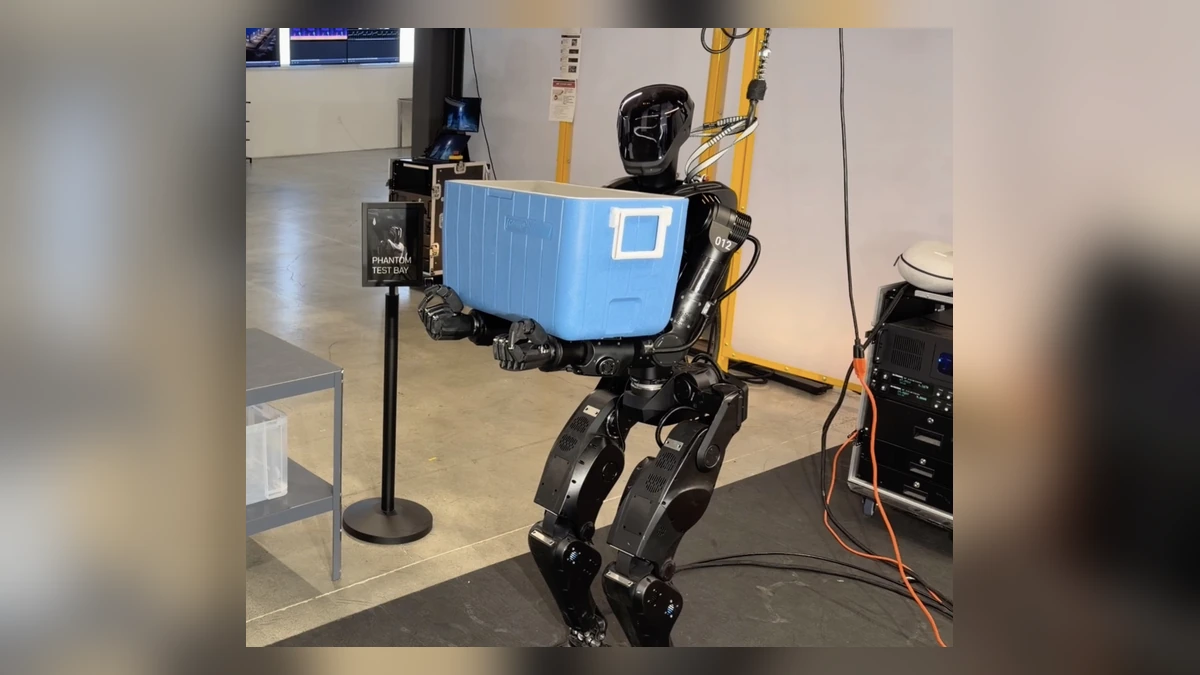
Foundation Future Industries, the San Francisco startup building humanoid robots for factory work and the military, said on July 23, 2026 that its Phantom robots will run on AMD’s newest embedded processors, a break from Nvidia (NVDA ), whose chips and software have been the default brains for most humanoid projects. The company disclosed the plan at AMD’s Advancing AI 2026 event, where AMD launched the Ryzen AI Embedded X100 Series processors that Foundation intends to use.
The choice matters less for the marketing figures attached to it than for who made it. Foundation is one of a short list of humanoid makers with robots doing paid work in customer facilities rather than running demo reels. A company at that stage is committing to a hardware and software stack it will have to support across a production fleet for years. Nvidia has spent those years making itself the obvious pick, from its Jetson edge modules to its Isaac robot-simulation software.
What the AMD stack actually brings
The X100 is AMD’s first embedded processor family aimed squarely at physical AI. Each chip pairs up to 16 of AMD’s “Zen 5” CPU cores with an integrated GPU and a dedicated neural-processing unit on one package, drawing on a shared pool of memory meant to cut the delay of shuttling data between them. AMD positions it for the perception and reasoning side of a robot: reading cameras, running vision and language models, and planning motion.
The more distinctive part of the pitch sits next to that chip. Foundation says it will use AMD’s field-programmable gate arrays, reconfigurable logic that excels at fast, predictable, repetitive control, to drive the robot’s hands and sensing. Andrea Esposito, who leads hand development at Foundation, said the FPGAs let its custom hand “actuate and coordinate all 23 degrees of freedom while fusing high-frequency tactile feedback in a single deterministic control loop,” according to Forbes. That capability traces to AMD’s 2022 acquisition of Xilinx, which invented the FPGA, and it is the piece a GPU-only stack struggles to match: a 23-joint hand closing a tight feedback loop needs timing guarantees, not just raw throughput.
The speed claims are harder to take at face value. Foundation says the X100 delivers 2.5 times faster inference and three times faster training than Nvidia, without naming which Nvidia parts, which models, or what test produced the numbers. AMD’s own comparisons are more specific and still vendor-run: it reports the X100 reaching up to three times the peak single-precision throughput of Nvidia’s Jetson T5000 and 3.5 times the token-generation rate of an Intel Core Ultra chip, all measured in its own labs. Both belong in the claim column, not the benchmark column, until independent hardware tests exist. The recurring lesson of physical AI is that datasheet numbers rarely survive contact with a factory floor.
A widening front against Nvidia
For AMD, Foundation is a showcase customer in a market it has barely begun to contest. Alongside the X100, the company introduced a Kria robotics platform and an open partner network that bundle its CPUs, GPUs, NPUs and FPGAs into one turnkey system for robot builders, a direct answer to the integrated hardware-and-software approach that made Nvidia the incumbent. AMD’s embedded chief, Kirk Saban, cast the new chips as a way to give autonomous systems more compute without locking developers into a single vendor’s tools.
The timing is deliberate. The same week, AMD detailed a far larger arrangement to supply Anthropic with up to two gigawatts of data-center GPUs, part of a broad campaign to erode Nvidia’s lead across AI compute. Robotics is a smaller prize today but a strategic one, because whoever supplies the brain for the first large humanoid fleets shapes the software habits of the industry. Rivals are chasing the same opening, visible in the capital flowing to industrial-humanoid makers such as Humanoid, which raised $152 million, and in the embodied-AI software stacks being built around them.
What Foundation has actually deployed
Foundation’s leverage in the deal rests on its deployment record. The company, founded in May 2024, says its Phantom robots work around the clock five days a week in customer plants, contributed to more than 24,000 cars built in 2025, and generate $100 million in contracted annual recurring revenue, figures that would place it among the very few humanoid makers earning real recurring income. Humanoids on live production lines are no longer unheard of, as with mimic robotics’ video-action models on Audi’s factory floor, but Foundation’s specific numbers are its own and unaudited, the kind of operational claim that is easy to assert and hard to check from outside.
The AMD silicon is aimed mostly at what comes next. Foundation says its forthcoming Phantom MK-2 will be built on AMD from the start and hardened for industrial and defense use, with tolerance for 100-G shocks, an IP67 dust-and-water rating and 360-degree vision. AMD says the X100 began sampling to customers in June 2026, with volume production expected in the fourth quarter of 2026, so the first robots actually shipping on the new chips are still months away.
Foundation also carries a political profile unusual for a robotics startup. Eric Trump, the president’s son, is an investor and the company’s chief strategy adviser, and Foundation holds about $24 million in Pentagon research contracts and has tested Phantom units in Ukraine, an arrangement Senator Elizabeth Warren has criticized as too cozy given the family tie. None of that settles the engineering question the AMD deal raises, which Foundation will answer only when MK-2 units run a full shift on the new chips and someone outside the company can measure how often a human still has to step in.



