AI Fundamentals
What Is Reinforcement Learning from Human Feedback (RLHF)?

 Add Unite.AI to your preferred sources on Google

Reinforcement learning from human feedback (RLHF) is a family of methods that uses human judgments to help optimize a model when the desired behavior is difficult to specify with a simple automatic reward. For language models, people commonly compare candidate responses and a learned preference model turns those comparisons into a training signal.
RLHF can make a pretrained model more helpful or better matched to a written policy, but it does not prove truthfulness or alignment with every user. The result depends on who supplies feedback, how prompts are sampled, what the reward model can represent, and how optimization is constrained.
Key takeaways
- RLHF usually follows pretraining and supervised instruction tuning.
- Pairwise preferences train a reward or preference model; policy optimization then favors higher-scoring outputs.
- Reward hacking, annotator disagreement, distribution shift, and overoptimization remain important risks.
- Evaluate the final policy directly for task quality, safety, calibration, and subgroup effects.
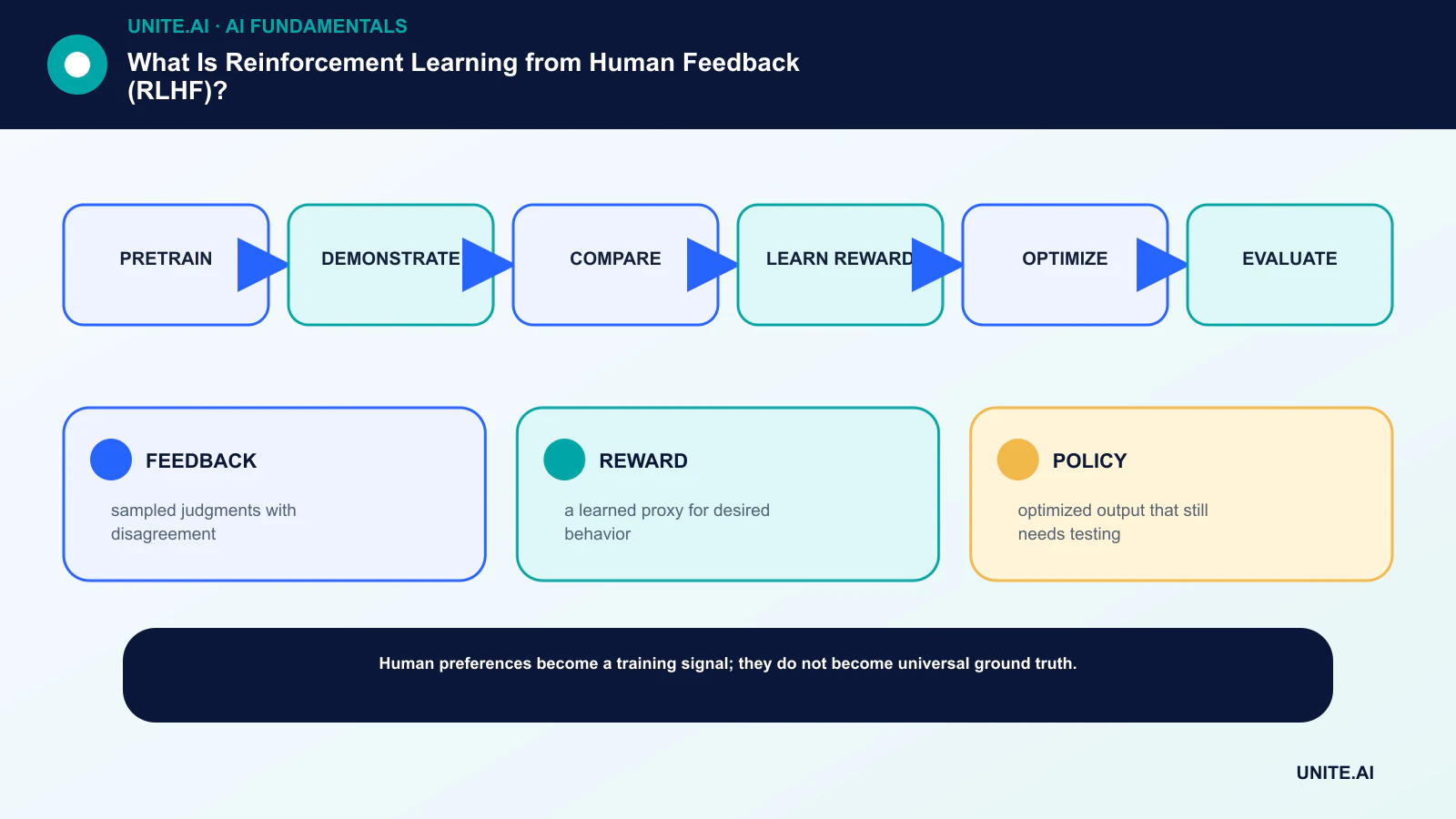
The common RLHF pipeline
A language model first learns broad statistical structure through pretraining. Supervised fine-tuning then uses demonstrations of desired responses. For preference collection, annotators rank or choose between outputs for the same prompt.
A reward model learns to predict those comparisons. A reinforcement-learning algorithm such as PPO can optimize the language model against that learned reward while a penalty discourages it from drifting too far from the reference policy.
Feedback is measurement, not ground truth
Annotators may disagree because instructions are ambiguous, expertise differs, or values genuinely conflict. Position, verbosity, confidence, and style can bias preferences. A high-quality program trains raters, measures agreement, audits examples, and preserves uncertainty.
Sampling also matters. If the preference set excludes difficult languages, domains, or harms, the reward model cannot reliably supervise them. Data-science discipline is as important as the optimizer.
Failure modes
The policy can exploit weaknesses in the learned reward, producing outputs that score well without satisfying the underlying intent. Excessive optimization may reduce diversity, amplify a preferred style, or make the model confidently agreeable.
The reward model itself can fail outside its training distribution. Teams should test adversarial prompts, factual tasks, refusal boundaries, calibration, and behavior at different optimization strengths rather than relying on one aggregate preference win rate.
Alternatives and complements
Direct Preference Optimization learns from preference pairs without fitting a separate policy through an online reinforcement-learning loop. Rejection sampling, supervised preference fine-tuning, rule-based feedback, and process supervision offer other trade-offs.
No method removes the need for prompt, retrieval, tool, and application-level controls. Post-training shapes behavior; deployed systems still require grounded evidence, permissions, monitoring, and human escalation.
How preference models are trained
For a prompt x and two responses y₁ and y₂, a preference model assigns scalar scores and is trained so the preferred response receives the higher score. A common loss is based on the probability that one score exceeds the other. This converts many pairwise judgments into a function that can score newly generated outputs.
The model learns whatever signals predict the collected choices. If raters prefer confident prose, longer answers, particular cultural norms, or familiar viewpoints, those correlations can become reward features. Balanced instructions, counterexamples, expert review, and audits for superficial preferences reduce but do not eliminate the problem.
Preference data can include ties, rankings, critiques, scalar labels, or demonstrations. Pair selection matters: comparisons between obviously different answers teach less about subtle quality boundaries, while only difficult pairs can make training unstable. Active sampling can target informative disagreements but may change the data distribution.
Policy optimization and regularization
PPO-based RLHF samples responses from the current policy, scores them with the reward model, and updates the policy to increase expected reward. A Kullback–Leibler penalty or related constraint keeps the policy near the supervised reference, limiting destructive drift and discouraging exploitation of narrow reward-model weaknesses.
Optimization strength is a product choice. Too little leaves desired behavior unchanged; too much can produce reward hacking, repetitive phrasing, sycophancy, or reduced diversity. Plot quality and safety metrics against reward and divergence throughout training rather than selecting a checkpoint by reward alone.
Direct preference methods derive an objective from preference pairs and a reference model without an explicit online RL loop. They can simplify training, but still inherit preference quality, coverage, and reference-policy assumptions. Constitutional or AI-generated feedback changes who supplies labels; it does not remove the need to validate values and failures with people.
Evaluation and data governance
Use blinded comparisons, task-specific tests, adversarial prompts, factuality checks, refusal precision and recall, and subgroup review. Separate evaluators from training data where possible. A win rate against an older model can hide absolute failures when both candidates are poor.
Document annotator recruitment, compensation, expertise, geography, language, instructions, exposure to harmful content, disagreement, adjudication, and quality controls. Feedback work can carry psychological risk, and responsible data operations include worker support and the right to decline disturbing tasks.
After deployment, monitor preference drift and overgeneralization. A policy tuned for casual assistance may behave badly in medical or legal contexts. Keep domain boundaries, retrieval, permissions, and escalation outside the RLHF assumption, and retrain only when new evidence justifies the change.
A concrete RLHF training and evaluation pipeline
A typical project begins with a pretrained language model and an instruction dataset used for supervised fine-tuning. Annotators then compare candidate responses under a written rubric covering correctness, relevance, style, safety, and uncertainty. Pairwise preferences train a reward model or directly optimize the policy. Sampling must include ordinary tasks, difficult edge cases, adversarial prompts, multiple languages, and areas where annotators legitimately disagree.
Reward-model accuracy on held-out comparisons is necessary but not sufficient. The optimized policy can exploit errors in the learned reward, become overly verbose, refuse harmless requests, or lose capabilities. Track task benchmarks, human preference, calibration, safety, diversity, and divergence from the reference model across training. Periodically collect fresh comparisons from the changing policy so the preference data covers outputs the model actually produces.
Document who provided preferences, their instructions, compensation, disagreement, quality controls, and cultural or domain limits. Use expert reviewers where mistakes carry specialized harm. Red-team both the reward model and final policy, maintain behavioral regression tests, and stage deployment. RLHF shapes behavior according to measured preferences; it does not prove truthfulness, eliminate bias, or solve the broader problem of specifying what a model should do in every context.
Practical implementation checklist
Turn the concept into a bounded, testable workflow: pretrain → demonstrate → compare → learn reward → optimize → evaluate. Name an accountable owner, document the data and dependencies, establish a simple baseline, set acceptance and stop criteria, test representative failures, and define monitoring, rollback, and review before expanding scope. Record versions and assumptions so another team can reproduce the result and understand what changed.
Before launch, run a documented readiness review with the people who build, operate, secure, and are affected by the system. Test normal cases, boundary conditions, dependency failures, and misuse; preserve the evidence and unresolved risks. Define who can approve release, change a threshold, override an output, or stop operation. Revisit the decision after real-world data arrives, because a technically successful pilot does not guarantee reliable performance at broader scale.
- FEEDBACK: sampled judgments with disagreement.
- REWARD: a learned proxy for desired behavior.
- POLICY: optimized output that still needs testing.
Frequently asked questions
Is RLHF the same as fine-tuning?
RLHF is a form of post-training that uses preference-derived rewards. Supervised fine-tuning directly trains on target outputs; many pipelines use both.
Does RLHF make a model truthful?
It can improve behavior measured by the feedback process, but a model may still be wrong, persuasive, or strategically exploit the reward. Truthfulness needs direct evaluation and grounding.
Primary references