
Thought Leaders
The Race to Deploy: Why Cooling Strategy Determines AI Success at Scale

 Add Unite.AI to your preferred sources on Google
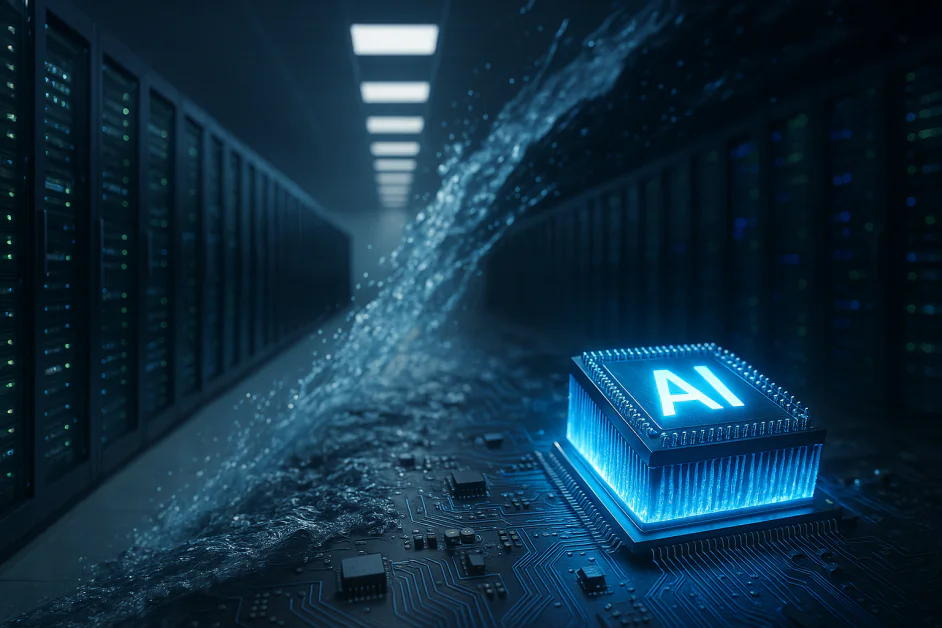
While headlines focus on AI capabilities and chip shortages, a silent crisis is unfolding inside data centers worldwide. The latest AI processors generate more heat than anything in computing history—up to 1,200W per chip and climbing. This fundamental physics challenge has become the true bottleneck in AI deployment, separating market winners from also-rans.
Organizations that solve this thermal puzzle aren’t just running cooler systems—they’re deploying AI capabilities months faster than competitors, extracting more compute from every precious megawatt, and creating sustainable competitive advantages that compound over time. Your cooling strategy has become your AI strategy, determining how quickly you can monetize AI investments and how efficiently you can scale.
The magnitude of this challenge becomes clear when examining recent market data. IDC forecasts that AI infrastructure spending will reach approximately $90 billion by 2028, yet many organizations are discovering that their existing cooling infrastructure cannot support the thermal demands of modern AI workloads. This infrastructure gap is creating a new competitive dynamic where thermal management capabilities directly determine market positioning.
Why Cooling Is Now Your Critical Path to AI Value
The Physics Barrier That Can’t Be Coded Around
Today’s AI servers consume 10-12kW each, with racks exceeding 100kW—intensities that traditional cooling methods simply cannot handle. To put this in perspective, a typical enterprise server rack consumes 5-10kW, representing a 10-20x increase in power density. Next-generation chips will push beyond 2,000W, with rack densities approaching 600kW.
The thermal challenge extends beyond individual processors to fundamentally reshape data center infrastructure. As AI hardware evolves on rapid annual cycles, organizations must design cooling systems that can adapt to continuously escalating power densities. Today’s 132kW rack requirements are driving mandatory adoption of liquid cooling solutions, as traditional air cooling simply cannot dissipate the heat generated by these high-density configurations. This creates a complex planning challenge: data center operators must simultaneously support current deployments while preparing infrastructure for next-generation processors that will push thermal demands even higher.
This isn’t a future concern; it’s an immediate deployment constraint that’s delaying AI initiatives today. The organizations treating thermal management as a strategic priority rather than a facilities afterthought are gaining months of competitive advantage in time-to-market.
From Cost Center to Strategic Advantage
The traditional view of cooling as a necessary operational expense fundamentally misunderstands its role in modern AI infrastructure. Cooling efficiency directly determines how much compute power you can extract from every constrained megawatt. Traditional cooling systems consume up to 40% of data center power, creating a massive opportunity cost in AI deployments where every watt of computing power translates directly to business value.
Organizations implementing advanced cooling solutions are achieving 20% more compute capacity from the same power envelope—effectively turning cooling efficiency into additional AI processing power without requiring new energy sources. This efficiency gain becomes even more critical as power constraints emerge as the primary limiting factor in AI infrastructure expansion.
The economic implications are substantial. For a typical enterprise AI deployment consuming 1MW of power, a 20% improvement in cooling efficiency translates to 200kW of additional computing capacity—equivalent to roughly 20 additional AI servers without requiring additional power infrastructure investment.
The Three-Part Decision Framework
The cooling strategy decision now requires evaluating three critical factors, each with significant business implications:
Current vs. future density requirements: Traditional cooling becomes impractical beyond 50kW per rack, with two-phase solutions offering significant advantages at 100kW+. Organizations must evaluate not just current requirements but projected density needs over the next 3-5 years. Industry analysis suggests that AI workload power densities will continue increasing by 15-20% annually, making forward-looking cooling architecture essential.
Deployment timeline pressure: In competitive AI markets, time-to-deployment directly correlates with market advantage. Solutions that accelerate time-to-market often deliver better business outcomes despite higher upfront costs. Organizations implementing modular cooling solutions report 40-60% faster deployment times compared to traditional cooling retrofits, often recovering the premium investment within the first year of operation.
Facility constraints: Existing power and cooling infrastructure create hard limits on deployment options. Hybrid approaches enable targeted high-density deployments within existing infrastructure, avoiding costly buildouts that can require 12-18 months and significant capital investment.
The Compounding Advantage
Future AI processors will only intensify thermal challenges. Whether it’s AMD’s MI300X or custom silicon from Google, Amazon (AMZN ), and Meta, the industry is pushing toward higher power densities that create unprecedented cooling demands. These processors are all designed for maximum performance density, making advanced thermal management essential for competitive AI deployments.
Organizations implementing scalable cooling architectures today are creating advantages that compound across multiple hardware generations. The most forward-thinking operators are designing for 250kW+ per rack, implementing sophisticated thermal monitoring systems, and developing integrated approaches that optimize cooling, power distribution, and compute resources as a unified system.
The New Reality of AI Infrastructure
The market is now clearly bifurcating between organizations that recognize cooling as a strategic imperative versus those treating it as a tactical challenge. As AI deployments accelerate throughout 2025, this gap will widen dramatically. Leading operators are already achieving deployment timelines measured in months rather than years, extracting significantly more compute from constrained power resources, and creating more sustainable operations with reduced energy consumption.
The sustainability implications are equally important. With traditional cooling systems consuming up to 40% of data center power, advanced cooling technologies that reduce this overhead directly support both operational efficiency and environmental sustainability goals
Taking Action: The Path Forward
The time for incremental cooling approaches has passed. Organizations that want to lead in AI must fundamentally rethink their thermal strategy now. This transformation requires viewing cooling infrastructure not as a supporting system but as a core enabler of AI capabilities.
Successful implementations begin with comprehensive thermal assessments that evaluate current infrastructure capabilities against projected AI workload requirements. Organizations should engage with cooling technology providers early in the AI planning process to ensure thermal strategies align with deployment timelines and business objectives.
The most successful AI deployments integrate cooling strategy into the initial infrastructure planning process rather than treating it as an afterthought. This integrated approach enables faster deployment, more efficient resource utilization, and greater long-term scalability.
In the AI era, your cooling infrastructure isn’t just supporting your technology—it’s determining how quickly you can create value from it. The future belongs to those who can deploy fast, scale efficiently, and adapt to rapidly evolving density requirements. The question isn’t whether to transform your cooling approach, but how quickly you can make the transition.



