
Artificial Intelligence
The Super-Agent Era: Why 2026 Is the Year AI Leaves the Chatbot Behind

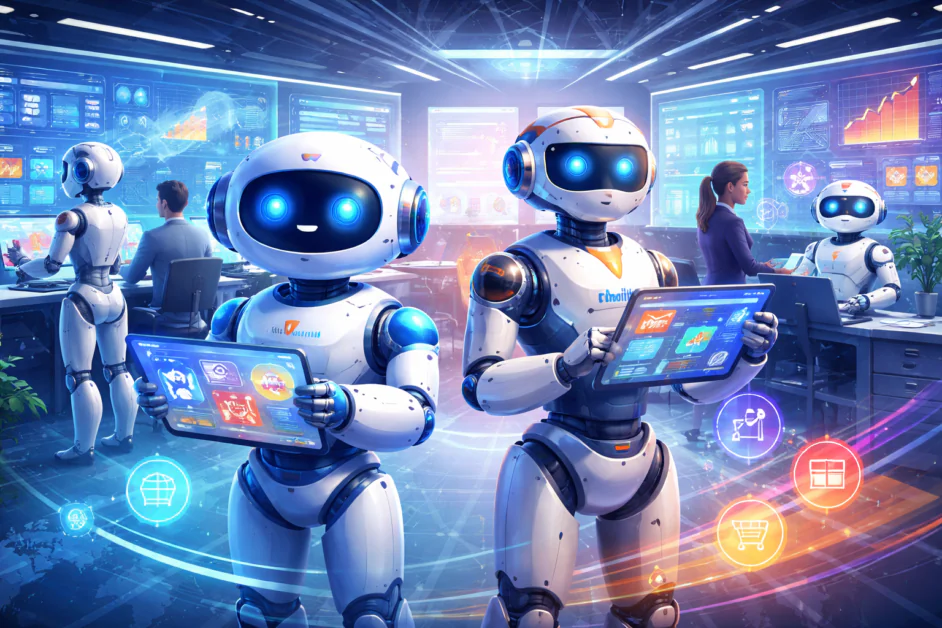
For years, the potential of Artificial Intelligence (AI) was limited by a single interface, the chat box. Between 2023 and 2025, the period commonly referred to as the Chatbot Era introduced conversational AI into enterprises, enabling systems to answer questions, summarize documents, draft emails, and provide guidance. Furthermore, these assistants represented significant progress, yet they remained fundamentally passive because humans still had to review suggestions, approve them, and complete every action.
As business operations became more complex, these limitations grew increasingly apparent. Consequently, teams no longer wanted AI that only summarized or advised; they desired systems capable of taking initiative, executing multi-step workflows, and connecting directly to production tools and enterprise data. In addition, this demand naturally led to the emergence of AI super-agents, autonomous systems designed to plan, decide, and act across enterprise environments with minimal human intervention.
By 2026, these technical and organizational shifts converge, marking a clear turning point. Therefore, AI moves beyond reactive chat interfaces and enters the Super-Agent Era, in which agents execute real work rather than merely generating responses. Analysts such as Gartner project that by this year, roughly 40% of enterprise applications will embed task-specific AI agents, up from less than 5% in 2025. Moreover, this growth marks the point at which AI stops simply assisting humans and begins functioning as an autonomous workforce alongside them.
From Chatbot Hype to the Super-Agent Era
The Chatbot Era brought noticeable efficiency gains, but it also revealed essential limitations. Traditional chatbots relied on scripted responses, decision trees, and limited memory. They could answer frequently asked questions, provide information, and guide users through simple processes. However, they still depended on humans to approve and complete even routine actions. Human oversight was not optional; it formed the foundation of how these systems operated.
Between 2024 and 2025, AI copilots began appearing in productivity tools and business applications. Embedded in email, documents, CRM systems, and code editors, these copilots helped employees draft messages, summarize reports, and suggest next steps. Nevertheless, they remained extensions of human work rather than independent agents. They could not consistently run multi-step workflows or take actions in the real world without a person in the loop.
The Super-Agent Era represents an apparent change in what AI can accomplish. Super-agents operate across multiple tools, applications, and systems. They can accept a goal, break it into steps, use the appropriate tools and APIs, execute actions, monitor results, and report back. Consequently, constant human intervention is no longer required, as these systems assume operational responsibility for achieving outcomes within defined boundaries. In addition, this marks a transition from reactive, suggestion-based AI to outcome-driven AI, where execution moves from the individual user to a coordinated, autonomous system.
What Exactly Is an AI Super-Agent?
An AI super-agent is an autonomous system designed to complete objectives rather than only respond to prompts. In contrast to traditional chatbots, which operate in a reactive, read-only mode, super-agents operate in a read-write mode. Therefore, they can plan multi-step workflows, interact with multiple systems, and make decisions based on context and feedback.
Super-agents often consist of several specialized agents working together. For example, one agent handles research, another organizes tasks, and a third executes actions within enterprise systems. Consequently, this collaboration enables the system to manage complex workflows efficiently. In addition, agents can connect to cloud applications, APIs, databases, CRMs, and communication platforms while maintaining context over time.
Several features distinguish super-agents from earlier AI systems. First, autonomy enables agents to take actions without step-by-step human input. Second, deep tool integration helps them perform tasks across internal software and external services. Third, memory supports learning about organizational processes and user preferences over extended periods. Furthermore, governance and safety mechanisms, including scoped permissions, human approval for high-impact actions, and comprehensive audit logs, ensure that agent operations follow defined boundaries and can be thoroughly reviewed.
Moreover, these properties enable super-agents to operate as reliable contributors in enterprise environments. Unlike chatbots or AI copilots, they can manage tasks end-to-end and achieve outcomes independently. At the same time, they provide human supervisors with transparency and oversight, which helps maintain accountability and trust.
Why 2026 Marks the Move from Chatbots to AI Super-Agents
The year 2026 represents a precise moment when enterprises begin using AI in a fundamentally different way. While chatbots helped with basic tasks and information retrieval, they depended on humans to complete even simple processes. In contrast, AI super-agents can manage multi-step workflows independently. They plan actions, use multiple applications, monitor results, and report back to humans. Consequently, the responsibility for execution moves from employees to the AI system, freeing teams to focus on higher-value work.
Several factors make this change possible. First, AI adoption across industries has grown steadily, but large-scale deployment of autonomous agents has only just begun. Surveys indicate that many organizations have tested AI in limited areas, but fewer than 10% have deployed agents in core operations. In addition, enterprises are now addressing this gap with dedicated strategies to integrate AI agents across applications and processes.
Second, technology has reached a level where coordinated AI operation is practical. Multi-agent orchestration frameworks, control dashboards, and integration tools enable multiple specialized agents to work together. These systems can follow rules, track progress, and execute tasks without constant human oversight. Research from enterprise providers shows that such setups reduce operational delays and improve decision-making speed. Therefore, organizations that implement these tools gain measurable efficiency improvements.
Third, economic conditions make agent deployment feasible for a wide range of businesses. Declining costs for computation, storage, and model hosting enable persistent, always-on agents at a reasonable expense. In addition, organizations that adopt these agents can reduce operational workload and increase output. Companies relying solely on chatbots may face slower processes and lower competitiveness compared with peers using autonomous agents.
Together, these trends make 2026 the year when enterprises move beyond chatbots. Moreover, it is the time when AI begins executing real operational work, not just supporting humans, creating opportunities for improved efficiency, faster decisions, and measurable outcomes across industries.
The Super-Agent Architecture and Autonomous Workflows
A super-agent works through several layers that coordinate reasoning, action, and oversight. At the center is a reasoning engine, usually a large language model or a combination of models. It interprets goals, plans multi-step workflows, and evaluates progress toward objectives. In addition, an integration layer connects the agent to databases, cloud applications, APIs, and automation tools. This gives the agent the ability to act directly within systems rather than only providing suggestions. Memory systems track organizational knowledge and past actions, helping the agent learn preferences, refer to earlier decisions, and handle tasks with continuity.
Above these layers, an orchestration system manages multiple specialized agents. Some focus on research, others on planning, execution, or review. A governance layer ensures permissions, policy compliance, and logging, so that every action is traceable and within defined limits. Consequently, large objectives can be divided into tasks, executed reliably across systems, and monitored for adherence, much as human teams assign responsibilities to maintain accuracy and accountability.
The practical effect of this architecture becomes clear with a real example. Imagine a logistics team facing shipping delays in Europe. A super-agent receives a goal to resolve the most urgent issues. The reasoning engine interprets the goal and uses the integration layer to gather data from internal systems, carrier APIs, and partner platforms. Planning agents propose rerouting options, and execution agents carry them out, updating internal systems and notifying customers and partners. Review agents continuously check results to ensure actions follow policy and meet operational constraints. If a situation exceeds defined limits or requires judgment beyond its rules, the system escalates to humans. Otherwise, the workflow continues automatically, adjusting in real-time to new information, such as unexpected delays or capacity changes.
This design creates a largely self-running loop where the system not only recommends actions but also executes and verifies them across the enterprise. Moreover, it shows how super-agents combine reasoning, execution, and oversight to reduce manual work, improve reliability, and maintain accountability in complex operations.
Super-Agents Already Driving Results Across Industries
While many organizations are still experimenting with AI, several global leaders have already moved beyond the chatbot stage to deploy super-agents that manage complex business processes independently. These examples show how autonomous AI delivers measurable outcomes and improves efficiency.
Walmart has implemented a system of four AI super-agents that work together across the company to manage different business areas. Each super-agent is designed to perform specific tasks autonomously while coordinating with the others. For example, Sparky is a super-agent that focuses on retail customers. It provides personalized shopping experiences by analyzing customer behavior and automates product reordering using computer vision. In addition, Marty manages suppliers by connecting fragmented systems, managing product catalogs, and automatically setting up advertising campaigns. These two super-agents operate alongside internal associate and developer agents, which assist employees by answering benefits-related questions and providing workforce data insights. Together, the four super-agents form an integrated system that reduces repetitive work, maintains oversight, and manages multiple operations simultaneously. Therefore, Walmart has moved from isolated AI tools to a coordinated framework of autonomous agents that execute tasks across the enterprise.
Likewise, Klarna, the digital bank, shows how super-agents can transform customer service and business operations. Its AI assistant handles 69-81% of all customer service interactions, performing work equivalent to over 850 full-time employees. In addition, the agent has reduced average resolution times from 11 minutes to less than 2 minutes while maintaining customer satisfaction scores comparable to those of human agents. Klarna also reports that this automation has contributed to a 40 million dollar improvement in annual profit, demonstrating that autonomous AI can drive both operational efficiency and business outcomes.
In the technology sector, Intercom’s Fin AI Agent illustrates the application of read-write super-agents for customer support. It serves over 6,000 companies, including Anthropic, where it handles tens of thousands of queries that previously required human intervention. Within a single month, the agent resolved more than half of these issues, saving the support team over 1,700 hours. Consequently, these examples show that super-agents can scale reliably even under high-volume and complex workloads.
Managing Risks and Governance in the Super-Agent Era
Greater autonomy introduces new risks, which increase as super-agents gain access to critical systems and data. Consequently, a single mistake could affect operations, trigger security incidents, or lead to compliance breaches, especially when sensitive information or regulated processes are involved. Moreover, regulatory frameworks such as the EU AI Act require organizations to maintain transparency, manage risks, and protect data. Failure to comply can result in penalties of up to €35 million or seven percent of global annual revenue, highlighting the importance of controlling AI behavior.
To manage these challenges, leading organizations are moving toward human-in-the-loop oversight instead of abandoning automation. In this approach, high-impact actions such as financial transactions, production changes, or customer-related decisions first pass through approval gates. Furthermore, comprehensive logging and auditing enable tracing, reviewing, and analyzing every agent decision after it occurs. In addition, governance policies clearly define what agents can do, which systems they can access, and the situations in which they must defer to humans. Therefore, super-agents can operate autonomously while remaining aligned with organizational rules, maintaining accountability, and reducing the likelihood of errors or compliance violations.
The Bottom Line
The Super-Agent Era marks a significant shift in how AI operates within organizations. In 2026, AI moves from giving suggestions to executing complex workflows across systems with minimal human help. Consequently, businesses that adopt super-agents can improve efficiency, reduce repetitive work, and achieve measurable results.
At the same time, autonomy brings responsibilities. Organizations must use human-on-the-loop oversight, transparent governance, and auditing to keep agents aligned with policies and regulations. Therefore, leaders who plan and manage super-agents carefully can combine human judgment with autonomous action to improve operations and outcomes.
The Super-Agent Era is not just the next step for AI. It is a new way of getting work done, where AI works alongside humans to deliver results rather than only providing guidance.



