
Thought Leaders
ISO 42001 Certification: Building Trust and Innovation in AI Governance

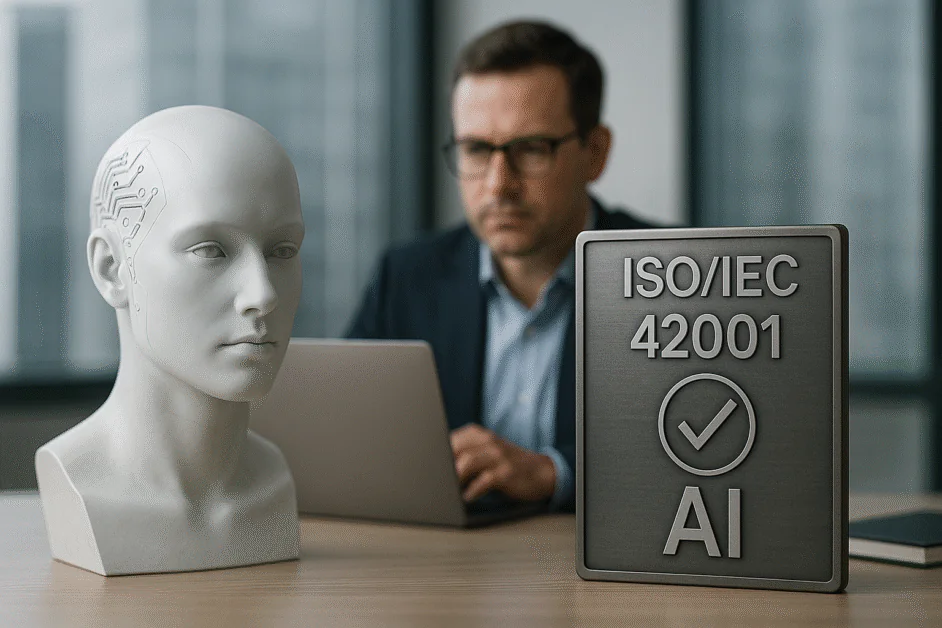
Artificial intelligence is reshaping modern business models at an unparalleled speed. For Chief Information Security Officers (CISOs), this revolution brings both power and pressure. As enterprises lean on AI for faster insights, higher efficiency, and competitive differentiation, one question dominates: How can organizations build trust in AI while navigating a rapidly evolving regulatory landscape?
What Is ISO/IEC 42001?
Published in December 2023 by the International Organization of Standardization and the International Electrotechnical Commission, ISO/IEC 42001 is the world’s first standard for AI management systems (AIMS).
Much like ISO 9001 for quality or ISO/IEC 27001 for information security, ISO 42001 provides a framework to establish, implement, maintain, and continually improve an AI management system. It applies to any organization that develops, provides, or uses AI systems, regardless of industry or size.
The goal of the standard, which is voluntary but internationally recognized, is to ensure AI is deployed responsibly, transparently, and safely throughout its entire lifecycle, from design to decommissioning.
For organizations considering ISO 42001, a structured roadmap can help align people, processes, and technology. The AI management system framework includes policies for governance structure, AI risk management processes, documentation and traceability requirements, human oversight mechanisms, and continual improvement reviews. Certification usually spans a three-year cycle with annual surveillance audits, embedding continuous compliance and operational maturity into AI oversight.
Why It Matters Now
The regulatory environment for AI is accelerating globally.
- The EU AI Act introduces tiered risk categories, conformity assessments, and transparency obligations for providers and deployers of AI.
- In the US, federal and state agencies have issued dozens of AI-related policies and rulemakings since 2024, doubling year-over-year activity and signaling movement toward a unified national framework.
- In Asia, Singapore, South Korea, and China are tightening data sovereignty and AI accountability requirements, intertwining local privacy laws with AI governance mandates.
For global enterprises, this patchwork of regulations means governance is now a strategic advantage.
Adopting ISO 42001 helps organizations get ahead of the curve. It provides documented, auditable processes for AI risk management, bias mitigation, and transparency, demonstrating regulatory readiness, AI traceability, and responsible innovation to investors, partners, customer, and regulators alike.
What ISO 42001 Doesn’t Do
ISO 42001 does not prescribe specific technical controls or guarantee compliance with every jurisdiction’s AI law. Instead, it ensures an organization has a system to manage how AI risks are identified, monitored, and mitigated.
Yet, for early adopters, these challenges become competitive strength as they can provide proof of operational maturity and foresight.
Leading by Example: Early Adopters Set the Pace
Only a small but growing number of organizations worldwide have achieved ISO 42001 certification. Early adopters, including technology, financial, and industrial firms, are setting the tone for responsible AI governance.
These pioneers aren’t waiting for regulations to dictate compliance. They’re shaping the rules by example, building stakeholder trust, and setting internal standards that exceed emerging regulatory requirements.
Commercial and Strategic Advantages
The process of implementing ISO 42001 can also increase visibility into how AI operates across the business. It helps organizations identify inefficiencies, clarify decision accountability, and align departments such as legal, engineering, compliance, and product.
For M&A technology providers like Datasite, certification has strengthened collaboration between engineering, legal, and product teams and has established a shared language for discussing AI risk, bias, and accountability. It’s also creating a tangible differentiator in procurement and partnership discussions where AI governance is increasingly a due-diligence requirement.
Trust Built Into Every Decision
As organizations expand their use of AI, ISO 42001 can integrate seamlessly with ESG reporting, AI assurance frameworks, and upcoming standards like ISO/IEC TR 42006 to build a holistic view of responsible, secure, and accountable AI operations.
AI’s potential is boundless, but so is its obligation.The organizations that thrive in this new era will be those that embed accountability, transparency, and continuous improvement into every stage of AI development.
ISO 42001 defines what responsible AI looks like and gives companies the tools to prove it.
At Datasite, where every transaction depends on confidentiality and trust, ISO 42001 certification is more than a badge. It’s a measurable, auditable, and globally recognized standard that assures clients their data, and the AI that supports it, are managed with the highest integrity.



