
Serie Futurista
10 Most Influential Women in AI and Robotics Transforming the Future

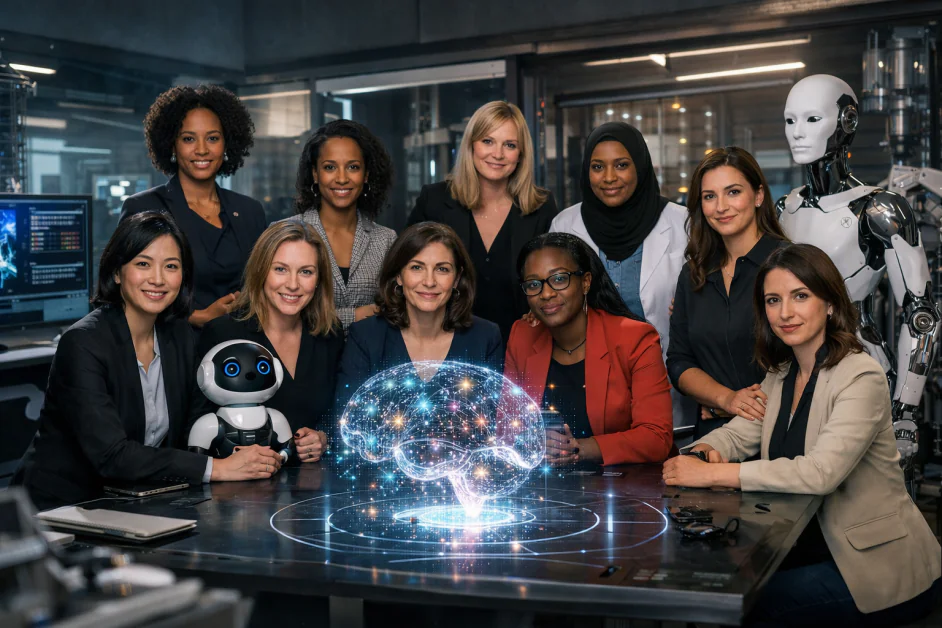
Artificial intelligence and robotics are no longer experimental fields confined to research labs. They are shaping economies, redefining industries, and influencing daily life at global scale. Behind many of the most important breakthroughs are women whose work has fundamentally altered how intelligent systems are designed, trained, governed, and deployed.
This list highlights ten of the most impactful women in AI and robotics today. These are researchers, engineers, and technical leaders whose contributions extend far beyond titles—women whose work has reshaped the trajectory of machine learning, embodied intelligence, and human-centered AI.
1. Dr. Fei-Fei Li

Photo: Steve Jurvetson, CC BY 2.0, via Wikimedia Commons
Dr. Fei-Fei Li is one of the foundational architects of modern computer vision. As the creator of ImagenNet, she led the effort to build the large-scale labeled dataset that ignited the deep learning revolution. ImageNet provided the training backbone that allowed neural networks to dramatically outperform previous computer vision methods, accelerating breakthroughs across object recognition, medical imaging, robotics, and autonomous systems.
Sus libros introductorios a las enseñanzas academic contributions at Stanford University helped formalize computer vision as a central pillar of AI research. By combining neuroscience-inspired approaches with deep learning systems, she helped shift AI from rule-based logic toward scalable pattern recognition.
Beyond technical achievement, Dr. Li has consistently championed human-centered AI. She argues that intelligence systems must be built with ethical safeguards, fairness considerations, and societal well-being in mind. Her work has influenced both academic research agendas and public policy discussions around responsible AI.
She has also served in advisorys that shaped national AI strategy in the United States, helping ensure that innovation aligns with democratic values and civil liberties.
Today, Dr. Li continues to lead research at the Stanford Human-Centered AI Institute, focusing on spatial intelligence, embodied AI, and ensuring that advanced systems augment human capability rather than replace it. Her work increasingly explores how AI can interact safely in real-world environments, bridging the gap between perception and action.
Dr. Li also chronicles her remarkable journey in her memoir Los mundos que veo, where she reflects on her path from immigrating to the United States as a teenager to becoming a pioneer of modern AI. The book provides a rare behind-the-scenes account of the creation of ImageNet and the early breakthroughs that helped launch the deep learning revolution.
2. Cynthia Breazeal

Photo: Cynthia Breazeal / CC BY-SA 4.0 / Wikimedia Commons
Cynthia Breazeal is widely credited with pioneering social robotics. At the MIT Media Lab, she developed Kismet, one of the earliest robots capable of interpreting and expressing emotions. This work helped launch the field of social robotics and laid the foundation for emotionally responsive machines and affective computing.
Her research redefined robotics by shifting the focus from industrial automation to social interaction. Rather than building machines that simply execute tasks, Breazeal explored how robots could communicate with people, build trust, and respond to human social cues.
Ella despues co-founded Jibo, a startup that developed one of the first consumer social robots designed for home environments. While the commercial path of Jibo was complex, the project represented a major milestone in bringing socially intelligent robotics into everyday life.
Breazeal’s influence extends deeply into education and healthcare robotics, where machines must understand subtle human signals to serve as effective companions, tutors, and assistants.
Today, she continues to lead the Grupo de robots personales at the MIT Media Lab andects initiatives focused on AI education and literacy. Her current work explores how socially intelligent AI systems and robots can support learning, well-being, and long-term human-AI relationships.
3. Timnit Gebru

Photo: TechCrunch / CC BY 2.0 / Wikimedia Commons
Timnit Gebru has been one of the most consequential voices in AI ethics. Her early research exposed bias in facial recognition systems, revealing significant disparities in accuracy across race and gender. The widely cited Sombras de género Estudio demonstrated that commercial systems performed far worse on darker-skinned women than on lighter-skinned men, prompting a broader reassessment of how AI systems are trained and evaluated.
She also co-authored influential research examining the risks of large language models, including their environmental impact, embedded bias, and lack of transparency. That work helped shift the conversation around AI development, encouraging the field to consider not only performance benchmarks but also the social and environmental consequences of scaling AI systems.
In 2021, Gebru founded the Distributed AI Research Institute (DAIR), an independent research organization dedicated to studying AI outside the influence of large technology companies. The institute focuses on community-driven research and emphasizes global participation in shaping the future of AI.
Her advocacy has influenced regulatory debates, industry standards, and broader discussions about responsible AI development.
Today, Gebru continues to focus on algorithmic accountability, data labor rights, and the power dynamics embedded in AI development. Her work increasingly examines how AI systems affect marginalized communities and how governance frameworks can be strengthened to ensure more equitable and transparent AI systems worldwide.
4. Daphne Koller

Photo: World Economic Forum / CC BY-SA 2.0 / Wikimedia Commons
Daphne Koller is a pioneer in probabilistic graphical modelos, a framework that allows machines to reason under uncertainty. Her academic work fundamentally shaped how AI systems represent complex dependencies in real-world data and helped establish probabilistic modeling as a core approach in modern machine learning.
She co-founded Coursera, one of the world’s largest online learning platforms, helping democratize access to AI and computer science education for millions of learners worldwide.
Koller later turned her focus toward biotechnology, founding Insitro to apply machine learning to drug discovery. By combining large-scale biological datasets with predictive modeling, the company aims to transform how therapies are discovered and developed.
Her work represents one of the clearest examples of AI transitioning from digital systems into the life sciences, where machine learning can accelerate scientific discovery.
Today, Koller continues to lead Insitro’s research into AI-driven pharmaceutical development, integrating genomics, high-throughput biology, and machine learning to accelerate clinical pipelines and improve the success rate of drug development.
5. Joy Buolamwini

Photo: Taylordw, CC0, via Wikimedia Commons
Joy Buolamwini’s groundbreaking research exposed racial and gender bias in facial recognition systems used by major technology companies. Her findings showed that error rates for darker-skinned women were dramatically higher than for lighter-skinned men, revealing how training data and system design can embed discrimination into widely deployed AI technologies.
The research helped spark global debate about algorithmic bias, leading to increased scrutiny of facial recognition systems and contributing to policy discussions around responsible AI deployment.
Buolamwini founded the Liga de justicia algorítmica to promote accountability and fairness in AI systems. Through the organization, she has worked to advance algorithmic auditing, public awareness, and industry standards aimed at reducing harmful bias in automated decision-making.
Her work bridges research, advocacy, and public engagement. Beyond academic research, she has brought attention to the societal impacts of AI through public speaking, policy engagement, and creative work that explores the relationship between technology and civil rights.
In recent years, Buolamwini has expanded her influence through writing and public advocacy, including her bestselling book Unmasking AI, which explores how algorithmic systems can encode discrimination and why stronger oversight and inclusive design are essential.
Today, Buolamwini continues to shape global conversations around AI governance, focusing on algorithmic auditing, regulatory frameworks, and ensuring that AI systems are tested across diverse populations before deployment.
6. Anca Dragan

Photo: Constructor University
Anca Dragan is a leading researcher in AI alignment and human-robot interaction. Her early academic work at UC Berkeley focused on enabling robots to infer human intent and collaborate safely with people, developing algorithms that allow machines to reason about human behavior and respond in ways that are predictable and cooperative.
She has worked extensively on intent inference, cooperative planning, and techniques that allow autonomous systems to learn from human feedback rather than relying on rigid predefined objectives. Her research has helped advance robots and AI agents that can operate alongside humans in environments ranging from autonomous vehicles to assistive robotics.
Dragan’s work addresses one of the most critical challenges in modern AI: ensuring that intelligent systems optimize for what people actually want rather than narrowly defined technical goals. Her research on value alignment, human-AI collaboration, and interpretable decision-making has influenced both robotics and broader discussions about AI safety.
In addition to her academic work, Dragan currently serves as Head of AI Safety and Alignment at Google DeepMind, where she leads teams focused on ensuring that frontier AI systems remain aligned with human goals and values as their capabilities continue to advance.
Today, her work continues to shape the development of safer and more human-compatible AI systems, combining advances in machine learning, robotics, and human-computer interaction to make intelligent technologies more interpretable, controllable, and beneficial to society.
7. Raia Hadsell

Raia Hadsell speaking at TEDxExeterSalon 2017_05” by TEDxExeter, CC BY-NC-ND 2.0
Raia Hadsell has played a major in advancing reinforcement learning and continual learning systems. At DeepMind, she helped develop algorithms that allow AI systems to learn continuously from experience rather than retraining from scratch on fixed datasets, addressing one of the central challenges in building adaptable intelligent agents.
Continual learning is essential for real-world robotics and AI systems, where environments evolve and machines must adapt while retaining previously learned knowledge. Hadsell’s research has focused on overcoming problems such as catastrophic forgetting, enabling neural networks to accumulate skills over time instead of losing earlier capabilities when learning new tasks.
Her work has also contributed to progress in embodied intelligence, where robots and autonomous agents learn through interaction with their environment rather than static supervision. By combining reinforcement learning, representation learning, and neuroscience-inspired approaches, she has helped advance systems that can navigate complex environments and generalize across tasks.
Hadsell joined DeepMind in 2014 and has since led research teams focused on lifelong learning and robotic navigation, contributing to foundational techniques such as policy distillation and progressive neural networks that enable knowledge transfer across tasks.
Today, as a senior research leader at Google DeepMind, Hadsell continues to focus on lifelong learning architectures and scalable embodied AI systems that can operate in dynamic real-world environments.
8. Ayanna Howard

Photo: Rob Felt / Georgia Institute of Technology
Ayanna Howard’s work has centered on assistive robotics and human-centered AI design. Her research has focused on building robotic systems that support children with developmental challenges, including therapy and educational technologies designed to help children with special needs develop motor and cognitive skills.
Earlier in her career, Howard worked as a robotics researcher at NASA’s Jet Propulsion Laboratory, where she contributed to autonomous robotic systems used for planetary exploration, including technologies designed for Mars rover missions.
She later transitioned into academia and leadership, founding the Human-Automation Systems Lab at Georgia Tech and launching Zyrobotics, a startup focused on developing AI-powered educational and therapy tools for children with diverse learning needs.
In 2021, Howard became the dean of the College of Engineering at The Ohio State University, making history as the first woman to lead the institution. In this, she continues to shape the future of engineering education while advancing research in human-robot interaction, AI safety, and inclusive technology design.
Today, Howard’s work spans research, entrepreneurship, and policy, with a focus on ensuring that robotics and artificial intelligence are designed to improve quality of life and expand equitable access to emerging technologies.
9. Rana el Kaliouby

Photo: Joi Ito, CC BY 2.0, via Wikimedia Commons
Rana el Kaliouby pioneered emotion AI through her work at Affectiva, the MIT Media Lab spin-off she co-founded to bring emotional intelligence into digital systems. The company developed technology capable of analyzing facial expressions and vocal cues to detect human emotions at scale, helping expand machine perception beyond objects and speech into human affect.
Emotion recognition has applications across industries, including automotive safety, media analytics, healthcare, and human-computer interaction. Affectiva’s technology was widely adopted by major companies before the firm was acquired by Smart Eye in 2021, marking a major milestone in the commercialization of emotion AI.
Following the acquisition, el Kaliouby shifted toward investing and mentorship within the AI ecosystem. She is now the co-founder and general partner of Blue Tulip Ventures, an early-stage venture firm focused on supporting startups building human-centric AI technologies.
Today, el Kaliouby remains a leading voice in emotionally intelligent AI, advocating for ethical deployment, diversity in AI development, and technologies that strengthen the relationship between humans and machines.
10. Mira Murati

Photo: OpenAI via AP
Mira Murati played a central in scaling generative AI to global adoption during her tenure as Chief Technology Officer at OpenAI. After joining the company in 2018 and becoming CTO in 2022, she helped lead the development and release of landmark systems such as ChatGPT, DALL-E, and the GPT-4 family of models—technologies that dramatically accelerated public and enterprise adoption of generative AI.
Murati’s leadership bridged cutting-edge research and real-world product deployment, ensuring that advanced models were accessible to developers, businesses, and consumers worldwide. Her work helped shape how large language models and generative systems are integrated into everyday workflows across industries.
In September 2024, Murati stepped down from OpenAI after more than six years at the company to pursue new projects and explore the next phase of AI development.
En 2025 fundó Laboratorio de máquinas pensantes, an artificial intelligence startup focused on building more capable and customizable AI systems and advancing multimodal AI that can interact with users through language, vision, and other modalities.
Today, Murati continues to influence theection of frontier AI through her work at Thinking Machines Lab, where she is building tools aimed at making advanced AI systems more widely understood, adaptable, and powerful for developers and organizations worldwide.
Together, these ten women represent a remarkable cross-section of the intellectual foundation behind modern AI and robotics. Their work spans foundational datasets, aprendizaje reforzado, human-robot interaction, gobernanza ética, and the rise of generative systems. Many of the technologies now transforming industries can be traced directly back to breakthroughs led by these researchers and engineers.
At the same time, highlighting their contributions is a reminder of something equally important: the field still needs far more women shaping its direction. Artificial intelligence is rapidly becoming one of the most consequential technologies ever developed. The systems being designed today will influence how societies function, how economies evolve, and how humans interact with intelligent machines.
Ensuring that these systems reflect diverse perspectives is not simply a matter of fairness. It is a matter of building better technology.
The women on this list demonstrate how powerful that influence can be. Their work has not only pushed the boundaries of AI research but has also expanded the conversation around how these technologies should be built and who they should serve. As the field continues to evolve, the next generation of women entering AI will play an equally critical in shaping a future where intelligent systems reflect the full diversity of human experience.



Serie Futurista
10 mest inflytelserika kvinnor inom AI och robotik som formar framtiden
Artificiell intelligens och robotik är inte längre experimentella områden som är begränsade till forskningslaboratorier. De formar ekonomier, omdefinierar branscher och påverkar vardagslivet i global skala. Bakom många av de viktigaste genombrotten står kvinnor vars arbete har förändrat hur intelligenta system designas, tränas, styrs och distribueras.
Den här listan belyser tio av de mest inflytelserika kvinnorna inom AI och robotik idag. Detta är forskare, ingenjörer och tekniska ledare vars bidrag sträcker sig långt bortom titlar – kvinnor vars arbete har omformat riktningen för maskininlärning, förkroppsligad intelligens och människocentrerad AI.
1. Dr. Fei-Fei Li
Photo: Steve Jurvetson, CC BY 2.0, via Wikimedia Commons
Dr. Fei-Fei Li är en av de grundläggande arkitekterna bakom modern datorseende. Som skaparen av ImagenNet ledde hon arbetet med att bygga den storskaliga märkta datamängd som tände den djupa inlärningsrevolutionen. ImageNet tillhandahöll träningsryggraden som gjorde det möjligt för neurala nätverk att dramatiskt överträffa tidigare datorseendemetoder, vilket accelererade genombrott inom objektigenkänning, medicinsk avbildning, robotik och autonoma system.
Hennes akademiska bidrag vid Stanford University hjälpte till att formalisera datorseende som en central pelare inom AI-forskning. Genom att kombinera neurovetenskapsinspirerade tillvägagångssätt med djupinlärningssystem hjälpte hon till att förskjuta AI från regelbaserad logik mot skalbar mönsterigenkänning.
Bortom tekniska prestationer har Dr. Li konsekvent förespråkat människocentrerad AI. Hon hävdar att intelligenta system måste byggas med etiska skyddsåtgärder, rättvisa överväganden och samhälleligt välbefinnande i åtanke. Hennes arbete har påverkat både akademiska forskningsagendor och offentliga policydiskussioner kring ansvarsfull AI.
Hon har också tjänstgjort i rådgivande roller som format nationell AI-strategi i USA, vilket hjälper till att säkerställa att innovation överensstämmer med demokratiska värderingar och medborgerliga friheter.
Idag fortsätter Dr. Li att leda forskning vid Stanford Human-Centered AI Institute, med fokus på rumslig intelligens, förkroppsligad AI och att säkerställa att avancerade system förstärker mänsklig förmåga snarare än ersätter den. Hennes arbete utforskar i ökande utsträckning hur AI kan interagera säkert i verkliga miljöer, och överbryggar klyftan mellan perception och handling.
Dr. Li skildrar också sin anmärkningsvärda resa i sin memoar Los mundos que veo, där hon reflekterar över sin väg från att immigrera till USA som tonåring till att bli en pionjär inom modern AI. Boken ger en sällsynt bakom kulisserna-berättelse om skapandet av ImageNet och de tidiga genombrotten som hjälpte till att lansera den djupa inlärningsrevolutionen.
2. Cynthia Breazeal
Photo: Cynthia Breazeal / CC BY-SA 4.0 / Wikimedia Commons
Cynthia Breazeal anses allmänt vara en pionjär inom social robotik. Vid MIT Media Lab utvecklade hon Kismet, en av de tidigaste robotarna kapabla att tolka och uttrycka känslor. Detta arbete hjälpte till att lansera området social robotik och lade grunden för känslomässigt responsiva maskiner och affektiv databehandling.
Hennes forskning omdefinierade robotik genom att förskjuta fokus från industriell automatisering till social interaktion. Istället för att bygga maskiner som bara utför uppgifter, utforskade Breazeal hur robotar kunde kommunicera med människor, bygga förtroende och svara på mänskliga sociala signaler.
Hon medgrundade senare Jibo, ett startup som utvecklade en av de första konsumentrobotarna för social interaktion designad för hemiljöer. Medan Jibos kommersiella väg var komplex, representerade projektet en stor milstolpe i att få socialt intelligent robotik in i vardagslivet.
Breazeals inflytande sträcker sig djupt in i utbildnings- och hälso- och sjukvårdsrobotik, där maskiner måste förstå subtila mänskliga signaler för att fungera som effektiva följeslagare, lärare och assistenter.
Idag fortsätter hon att leda Grupo de robots personales vid MIT Media Lab och leda initiativ med fokus på AI-utbildning och litteracitet. Hennes nuvarande arbete utforskar hur socialt intelligenta AI-system och robotar kan stödja lärande, välbefinnande och långsiktiga människa-AI-relationer.
3. Timnit Gebru
Photo: TechCrunch / CC BY 2.0 / Wikimedia Commons
Timnit Gebru har varit en av de mest betydelsefulla rösterna inom AI-etik. Hennes tidiga forskning avslöjade bias i ansiktsigenkänningssystem och visade på betydande skillnader i noggrannhet över ras och kön. Den vida citerade Sombras de género-estudiar demonstrerade att kommersiella system presterade mycket sämre på mörkhyade kvinnor än på ljushyade män, vilket utlöste en bredare omprövning av hur AI-system tränas och utvärderas.
Hon var också medförfattare till inflytelserik forskning som undersökte riskerna med stora språkmodeller, inklusive deras miljöpåverkan, inbäddad bias och brist på transparens. Det arbetet hjälpte till att förskjuta samtalet kring AI-utveckling och uppmuntrade området att överväga inte bara prestandamått utan också de sociala och miljömässiga konsekvenserna av att skala AI-system.
År 2021 grundade Gebru Distributed AI Research Institute (DAIR), en oberoende forskningsorganisation dedikerad till att studera AI utanför stora teknikbolags inflytande. Institutet fokuserar på samhällsdriven forskning och betonar globalt deltagande i att forma framtiden för AI.
Hennes förespråkande har påverkat regleringsdebatter, branschstandarder och bredare diskussioner om ansvarsfull AI-utveckling.
Idag fortsätter Gebru att fokusera på algoritmisk ansvarighet, datalaborrättigheter och maktrelationer inbäddade i AI-utveckling. Hennes arbete undersöker i ökande utsträckning hur AI-system påverkar marginaliserade samhällen och hur styranderamverk kan stärkas för att säkerställa mer rättvisa och transparenta AI-system världen över.
4. Daphne Koller
Photo: World Economic Forum / CC BY-SA 2.0 / Wikimedia Commons
Daphne Koller är en pionjär inom probabilistiska grafiska modelador, ett ramverk som låter maskiner resonera under osäkerhet. Hennes akademiska arbete formade fundamentalt hur AI-system representerar komplexa beroenden i verklig data och hjälpte till att etablera probabilistisk modellering som ett kärntillvägagångssätt inom modern maskininlärning.
Hon medgrundade Coursera, en av världens största onlineinlärningsplattformar, vilket hjälpte till att demokratisera tillgång till AI- och datavetenskapsutbildning för miljontals elever världen över.
Koller vände senare sitt fokus mot bioteknik och grundade Insitro för att tillämpa maskininlärning på läkemedelsupptäckt. Genom att kombinera storskaliga biologiska datamängder med prediktiv modellering syftar företaget till att förvandla hur terapier upptäcks och utvecklas.
Hennes arbete representerar ett av de tydligaste exemplen på AI som övergår från digitala system till livsvetenskaper, där maskininlärning kan påskynda vetenskapliga upptäckter.
Idag fortsätter Koller att leda Insitros forskning inom AI-driven läkemedelsutveckling, och integrerar genomik, högeffektiv biologi och maskininlärning för att påskynda kliniska pipelines och förbättra framgångsgraden för läkemedelsutveckling.
5. Joy Buolamwini
Photo: Taylordw, CC0, via Wikimedia Commons
Joy Buolamwinis banbrytande forskning avslöjade ras- och könsbias i ansiktsigenkänningssystem som används av stora teknikbolag. Hennes resultat visade att felfrekvensen för mörkhyade kvinnor var dramatiskt högre än för ljushyade män, vilket avslöjade hur träningsdata och systemdesign kan inbädda diskriminering i vitt spridda AI-teknologier.
Forskningen hjälpte till att utlösa global debatt om algoritmisk bias, vilket ledde till ökad granskning av ansiktsigenkänningssystem och bidrog till policydiskussioner kring ansvarsfull AI-distribution.
Buolamwini grundade Liga de justicia algorítmica för att främja ansvarighet och rättvisa i AI-system. Genom organisationen har hon arbetat för att främja algoritmisk revision, medvetenhet hos allmänheten och branschstandarder som syftar till att minska skadlig bias i automatiserat beslutsfattande.
Hennes arbete överbryggar forskning, förespråkande och offentligt engagemang. Bortom akademisk forskning har hon uppmärksammat AI:s samhällspåverkan genom offentliga tal, policyengagemang och kreativt arbete som utforskar förhållandet mellan teknologi och medborgerliga rättigheter.
Under de senaste åren har Buolamwini utökat sitt inflytande genom skrivande och offentligt förespråkande, inklusive hennes bästsäljande bok Unmasking AI, som utforskar hur algoritmiska system kan koda in diskriminering och varför starkare tillsyn och inkluderande design är avgörande.
Idag fortsätter Buolamwini att forma globala samtal kring AI-styrning, med fokus på algoritmisk revision, regelverk och att säkerställa att AI-system testas över olika befolkningsgrupper innan distribution.
6. Anca Dragan
Photo: Constructor University
Anca Dragan är en ledande forskare inom AI-justering och människa-robotinteraktion. Hennes tidiga akademiska arbete vid UC Berkeley fokuserade på att göra det möjligt för robotar att härleda mänsklig avsikt och samarbeta säkert med människor, och utvecklade algoritmer som låter maskiner resonera om mänskligt beteende och svara på sätt som är förutsägbara och samarbetsvilliga.
Hon har arbetat omfattande med avsiktshärledning, kooperativ planering och tekniker som låter autonoma system lära sig från mänsklig feedback snarare än att förlita sig på stela fördefinierade mål. Hennes forskning har hjälpt till att främja robotar och AI-agenter som kan verka tillsammans med människor i miljöer som sträcker sig från autonoma fordon till assistiv robotik.

