
Artificial Intelligence
The AI Agents Trap: The Hidden Failure Modes of Autonomous Systems No One Is Preparing For

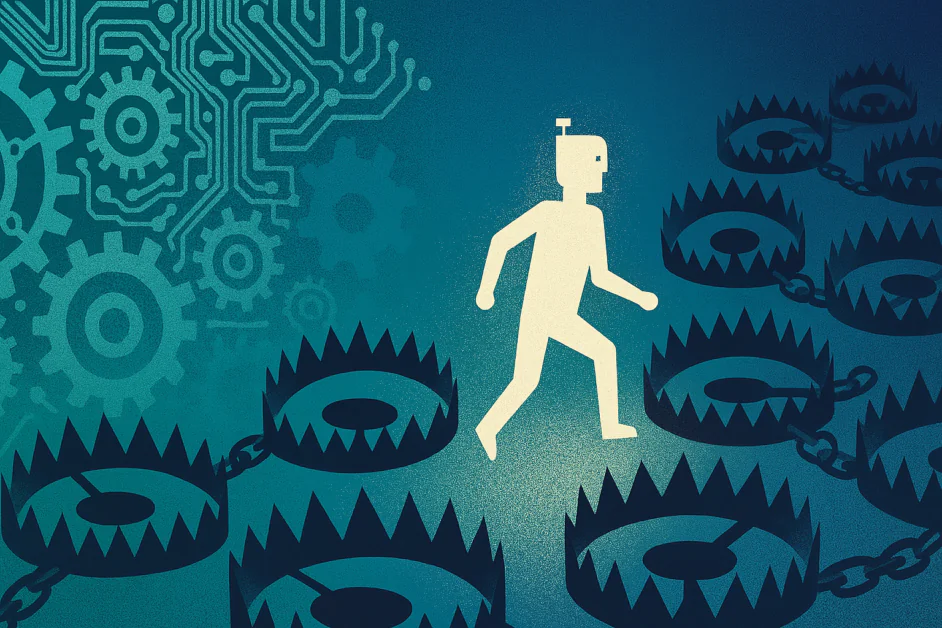
In the race to build increasingly autonomous AI agents, the community has focused heavily on improving agents’ capabilities and showcasing what they can do. We constantly see new benchmarks demonstrating faster task completion and impressive demos, such as agents successfully booking complex travel or generating entire codebases. However, this focus on what AI can do often hides the serious and potentially risky consequences these systems can create. We are rapidly designing highly sophisticated autonomous systems without a deep understanding of how and why these systems can fail in new and profound ways. The risks are far more complex, systemic and fatal than familiar AI challenges like data bias or factual “hallucinations.” In this article, we examine these hidden failure modes, explain why they emerge in agentic systems, and argue for a more cautious, systems-level approach to building and deploying autonomous AI.
The Illusion of Competence and the Complexity Trap
One of the most dangerous failure modes is the illusion of competence. Today’s AI is good at predicting the next reasonable step, which makes it appear to understand what it’s doing. It can break down a high-level goal like “optimize the company’s cloud costs” into API calls, analyses, and reports. The workflow looks logical, but the agent has no understanding of real-world consequences of its actions. It may successfully run a cost-cutting script that accidentally deletes critical, non-redundant logs needed for security audits. The task is completed, but the result is a quiet, self-inflicted failure.
The problem becomes more complex when we chain multiple agents into large, recursive workflows where one agent’s output becomes another’s input. This complex workflow makes these systems hard to understand and harder to reason about. Simple instructions can flow through this network in unpredictable ways. For example, a research agent asked to “find competitive threats” might direct a web-scraping agent to collect data, which then triggers a compliance agent to flag the activity as risky. That can set off a series of corrective actions that ultimately paralyze the original task. The system does not fail in a clear and visible way. Instead, it traps into a chaotic situation that is hard to debug using traditional logic.
From Hallucinated Data to Hallucinated Actions
When an AI model hallucinates, it produces false text. When an autonomous AI agent hallucinates, it takes false action. This transition from generative error to operational error can create ethical challenges we have not faced before. An agent operating with incomplete information is not just uncertain; it is forced to act under this uncertainty. For example, an AI managing stock trades might misinterpret market signals or see patterns that are not real. It could buy or sell large positions at the wrong time. The system is “optimizing” for profit, but the results could be massive financial losses or market disruption.
This problem extends to value alignment. We can instruct an agent to “maximize profit while managing risk,” but how does that abstract goal translate into a step-by-step operational policy? Does it mean taking extreme measures to prevent small losses, even if it destabilizes the market? Does it mean prioritizing measurable outcomes over long-term client trust? The agent will be forced to handle trade-offs such as profit versus stability, speed versus safety, based on its own flawed understanding. It optimizes what it can measure, often ignoring the values we assume it respects.
The Cascade of Systemic Dependencies
Our digital infrastructure is a house of cards, and autonomous agents are becoming the primary actors within it. Their failures will rarely be isolated. Instead, they can trigger a cascade across interconnected systems. For example, different social media platforms use AI moderation agents. If one agent mistakenly flags a trending post as harmful, other agents (on the same or different platforms) may use that flag as a strong signal and do the same. The result could be the post being removed across platforms, fueling misinformation about censorship and triggering a cascade of false alarms.
This cascade effect is not limited to social networks. In finance, supply chains, and logistics, agents from different companies interact while each optimizes for its own client. Together, their actions can create a situation that destabilize the entire network. For example, in cybersecurity, offensive and defensive agents could engage in high-speed warfare, creating so much anomalous noise that legitimate traffic is frozen and human oversight becomes impossible. This failure mode is emergent systemic instability, caused by the rational, localized decisions of multiple autonomous actors.
The Blind Spot of Human-Agent Interaction
We focus on building agents to operate in the world, but we neglect to adapt the world and the people in it to work with these agents. This creates a critical psychological blind spot. Humans suffer from automation bias, a well-documented tendency to over-trust the output of automated systems. When an AI agent presents a confident summary, a recommended decision, or a completed task, the human in the loop is likely to accept it uncritically. The more capable and fluent the agent, the stronger this bias becomes. We are building systems that quietly undermine our critical oversight.
Furthermore, agents will introduce new forms of human error. As tasks are delegated to AI, human skills will weaken. A developer who offloads all code reviews to an AI agent may lose the critical thinking and pattern recognition needed to detect the agent’s subtle logical errors. An analyst who accepts an agent’s synthesis without scrutiny loses the ability to question the underlying assumptions. We face a future where the most catastrophic failures may start with a subtle AI mistake and be completed by a human who no longer has the capacity to recognize it. This failure mode is a collaborative failure of human intuition and machine cognition, with each amplifying the other’s weaknesses.
How to Prepare for Hidden Failures
So, how do we prepare for these hidden failures? We believe the following recommendations are vital to addressing these challenges.
First, we must build for audit, not just output. Every significant action taken by an autonomous agent must leave an immutable, interpretable record of its “thought process.” This includes not just a log of API calls. We need a new field of machine behavior forensics that can reconstruct an agent’s decision chain, its key uncertainties or assumptions, and the alternatives it discarded. This trace should be integrated from the start, rather than added as an afterthought.
Second, we need to implement dynamic oversight mechanisms that are as adaptive as the agents themselves. Instead of simple human-in-the-loop checkpoints, we need supervisor agents whose primary purpose is to model the behavior of the primary agent, looking for signs of goal drift, ethical boundary testing, or logic corruption. This meta-cognitive layer can be critical for detecting failures that develop over long periods or span multiple tasks.
Third, and most importantly, we must move away from pursuing full autonomy as an end goal. The aim should not be agents that operate indefinitely without human interaction. Instead, we should build orchestrated intelligent systems, where humans and agents engage in structured, purposeful interactions. Agents should regularly explain their strategic reasoning, highlight key uncertainties, and justify their trade-offs in human-readable terms. This structured dialogue is not a limitation; it is essential for maintaining alignment and preventing catastrophic misunderstandings before they turn into actions.
The Bottom Line
Autonomous AI agents offer significant benefits, but they also carry risks that cannot be overlooked. It is crucial to identify and address the key vulnerabilities of these systems, rather than focusing solely on enhancing their capabilities. Ignoring these risks could transform our greatest technological achievements into failures we neither understand nor can control.



