
Book Reviews
Book Review: The Rise of Logical Data Management by Christopher Gardner

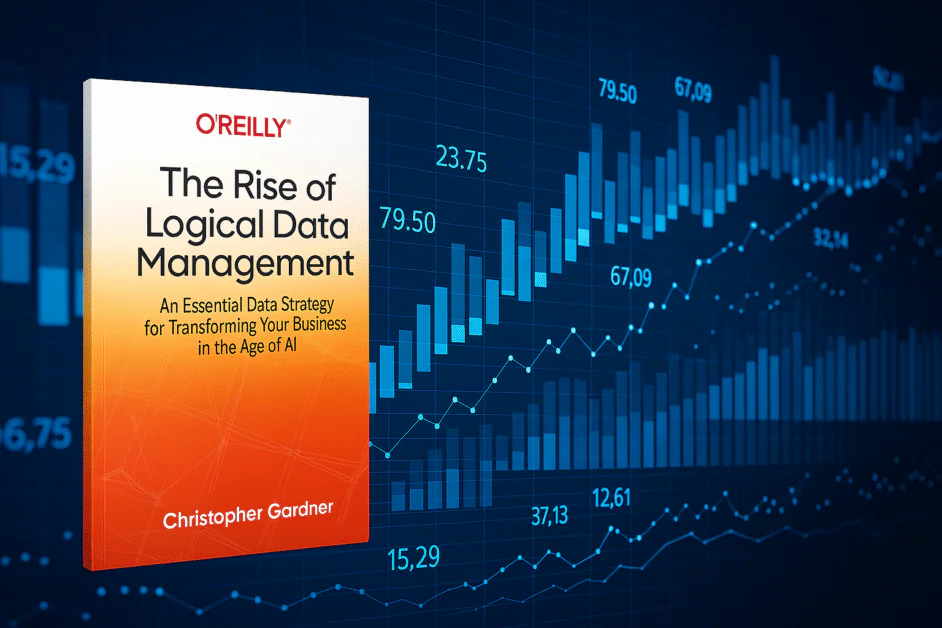
The Rise of Logical Data Management by Christopher Gardner is a thoroughly researched and timely guide for understanding how organizations can rethink their data architecture at a moment when AI, decentralization, and real-time insights are redefining what businesses expect from their information systems. While the topic is unquestionably niche, Gardner elevates it into a strategic discussion that applies not only to large enterprises with massive data estates, but also to startups building AI-driven products that require clean, consistent, and flexible access to information. The book’s greatest strength is its clarity—Gardner manages to take a sophisticated, technically demanding subject and explain it in a way that remains practical, actionable, and deeply relevant.
Logical Data Management vs. Traditional Data Management
At the center of Gardner’s argument is a paradigm shift: instead of repeatedly copying and consolidating data across warehouses, lakes, SaaS applications, and operational systems, organizations can operate through a logical (virtual) data layer that sits above all existing resources. This layer allows users and systems to access data where it currently resides, without needing physical replication. It becomes a kind of universal interface for analytics, governance, security, and AI.
This sharply contrasts with traditional approaches that rely heavily on ETL (Extract, Transform, Load) pipelines, which move data from its original system into a new storage environment. While ETL is powerful, Gardner shows how it often introduces delays, creates duplication, increases maintenance costs, and becomes rigid as organizations scale. Logical data management removes the dependency on constant data movement, reducing the operational burden and dramatically increasing the flexibility of a data ecosystem.
Gardner’s explanation of this difference is accessible even for readers who do not come from a data engineering background. He illustrates how the logical layer changes the entire lifecycle of data—from ingestion to delivery—by decoupling data access from physical storage.
How Logical Data Management Supports Data Mesh and Data Fabric
One of the most valuable contributions of the book is how it clarifies the relationship between data mesh and data fabric, two concepts that are widely discussed but often misunderstood. Gardner does not treat them as competing philosophies; instead, he shows how they both rely on logical data management to succeed.
A data mesh emphasizes decentralized ownership, where individual domains—such as marketing, finance, or operations—control their own data as products. This enables faster iteration and reduces bottlenecks tied to central data teams. A data fabric, by contrast, focuses on the automation and metadata-driven integration that connects distributed systems into a cohesive whole.
Gardner’s key insight is that both models require a unifying logical layer. Without logical data management, a mesh becomes too fragmented to govern effectively, and a fabric becomes too complex to maintain. In practice, the logical layer provides the federation, governance, and consistency that make both architectural patterns sustainable. This section alone makes the book an excellent foundational read for anyone working with modern data platforms.
Semantic Models, Data Virtualization, and Enhanced Performance
Midway through the book, Gardner introduces the topics that bring logical data management to life: semantic models and data virtualization. These chapters are particularly well written and accessible, especially considering how abstract these concepts can be.
A semantic model defines business concepts—customers, transactions, products—in a unified way that hides the complexity of the underlying systems. Gardner demonstrates how this shared vocabulary enables analysts, developers, and AI systems to query data using consistent definitions, even when the physical data is spread across different platforms.
The discussion on data virtualization is equally strong. Gardner walks through how virtualization engines can intelligently query data sources in real time, push computation to the right locations, merge results, and optimize performance without unnecessary data movement. For organizations struggling with scalability or managing multiple analytical environments, these explanations provide a clear path forward.
Governance, Security, and Operational Clarity
Beyond architecture, Gardner dedicates meaningful attention to data governance and security, showing how the logical layer simplifies policy enforcement across diverse systems. Because the logical layer centralizes access, organizations can manage permissions, privacy controls, auditing, and usage policies in one place, rather than managing fragmented rules across dozens of databases and platforms.
This approach is particularly beneficial for regulated industries or companies handling sensitive information. Gardner avoids abstract generalities and instead highlights practical scenarios where logical data management strengthens compliance without slowing down innovation.
The Critical Intersection: Logical Data Management and AI
One of the standout sections of the book explores how AI and logical data management enhance one another. Gardner presents a compelling argument that as AI becomes central to business operations, organizations will need a unified, reliable, and semantically consistent data layer to support model training, real-time inference, and automated decision-making.
Even more interesting is the inverse: AI can automate and enrich the logical layer itself. Gardner describes how AI can help build semantic models, maintain metadata, detect data irregularities, and optimize virtualization strategies. The interplay between AI and logical data management positions the latter as a foundational layer for the emerging AI-driven enterprise.
A Forward Look at a Data-Driven, AI-Powered Future
The book closes with a forward-looking reflection on how organizations will evolve as AI-driven integration becomes standard. Gardner emphasizes that logical data management creates a foundation that is adaptable, scalable, and ready for change—capable of absorbing new data sources, evolving with business needs, and powering increasingly intelligent applications.
For readers looking for a modern, strategic approach to data architecture, The Rise of Logical Data Management is not just informative—it is essential.


